Does chunked content get cited more by AI search?
I asked four AI search tools 30 questions and scored 994 cited and skipped pages for chunking. Rank and length predicted citation, chunking didn't.
Key findings
Bottom line: pages written in self-contained chunks weren't cited more often by AI search than the other pages competing for the same question. Ranking well in Google and being a longer page predicted citation. Chunking didn't, apart from a small lean in ChatGPT that a second test pointed to again but couldn't confirm.
- Chunking didn't explain which top-10 pages got cited. 71% of the Google top-10 pages an AI tool cited were rated chunked, against 61% of the ones it skipped. The cited pages also ranked higher and were longer, and once rank and length were taken into account, the gap disappeared.
- Rank and length did predict citation. Pages that ranked higher in Google, and longer pages, were more likely to be cited than other pages for the same question.
- ChatGPT leaned slightly toward chunked pages, but it isn't confirmed. Of the pages ChatGPT read before answering, the ones it cited scored a little higher on chunking (7.9 against 7.6 out of 10). On 30 new questions the lean was about the same size but wasn't statistically significant.
- Most pages are already chunked. About 60% of the pages I scored were rated chunked, so most of the pages an AI tool chooses between look alike on this measure.
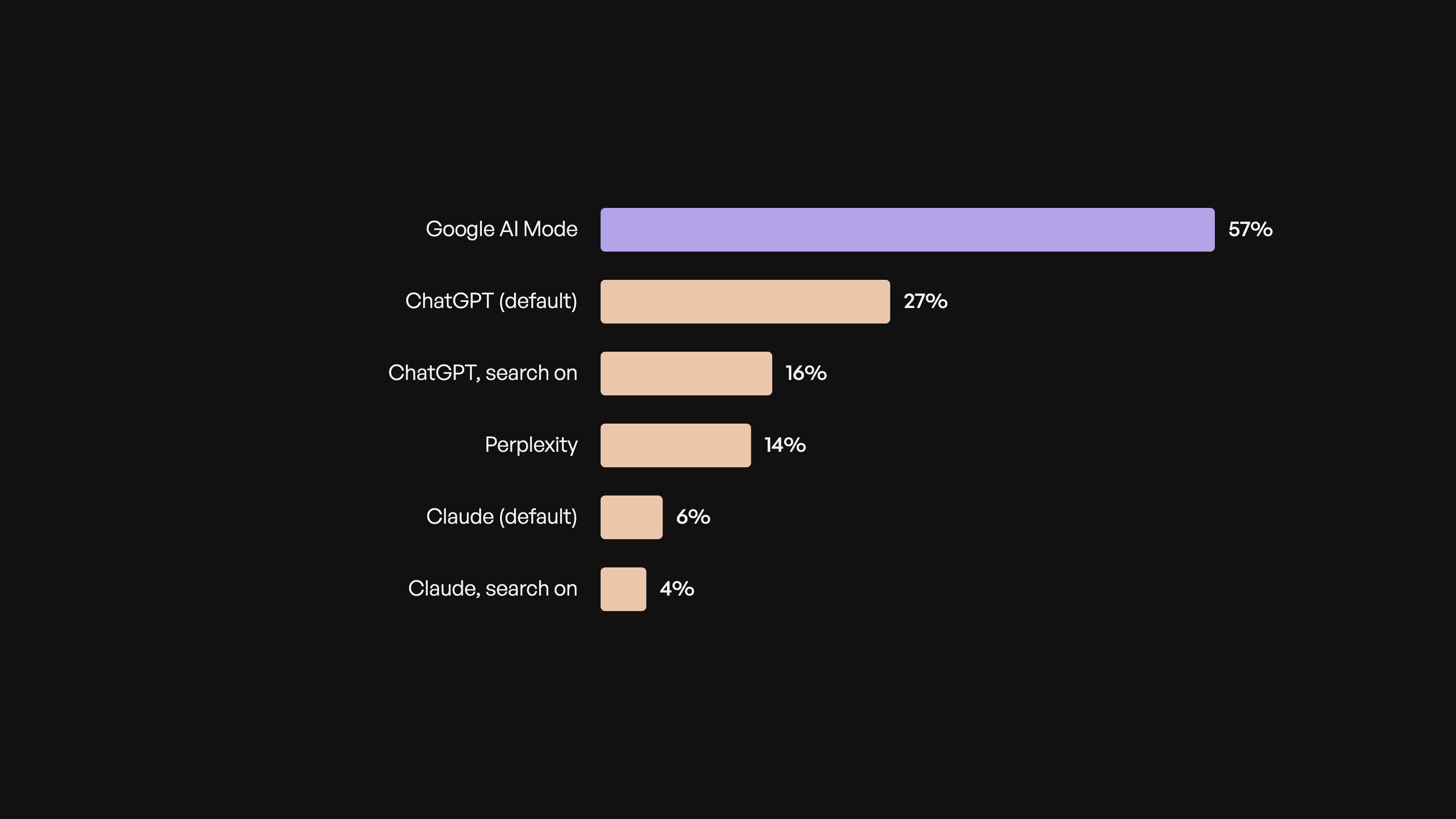
- Each tool draws from its own pool of pages. 57% of the pages Google AI Mode cited were in Google's top 10 for the same question, compared with 27% or less for every other tool.
How I tested it
I asked ChatGPT, Claude, Perplexity and Google AI Mode the same 30 everyday questions, twice each, and recorded every page they cited. For each question I also kept Google's top 10 results and, for ChatGPT, every page it opened while answering, including the ones it didn't cite.
Each page got a chunking score out of 10 from a scorer who couldn't see whether it had been cited. The score covers five things: headings that say what the section answers, the answer coming first, sections that make sense on their own, one topic per section, and sections short enough to quote. Pages scoring 8 or more count as chunked.
That gave two comparisons: top-10 pages an AI tool cited against top-10 pages it skipped, and pages ChatGPT read and cited against pages it read and passed over. Each page was only compared with other pages for the same question. I then repeated the ChatGPT comparison on 30 new questions. The full method is in the Methodology section at the end.
Results
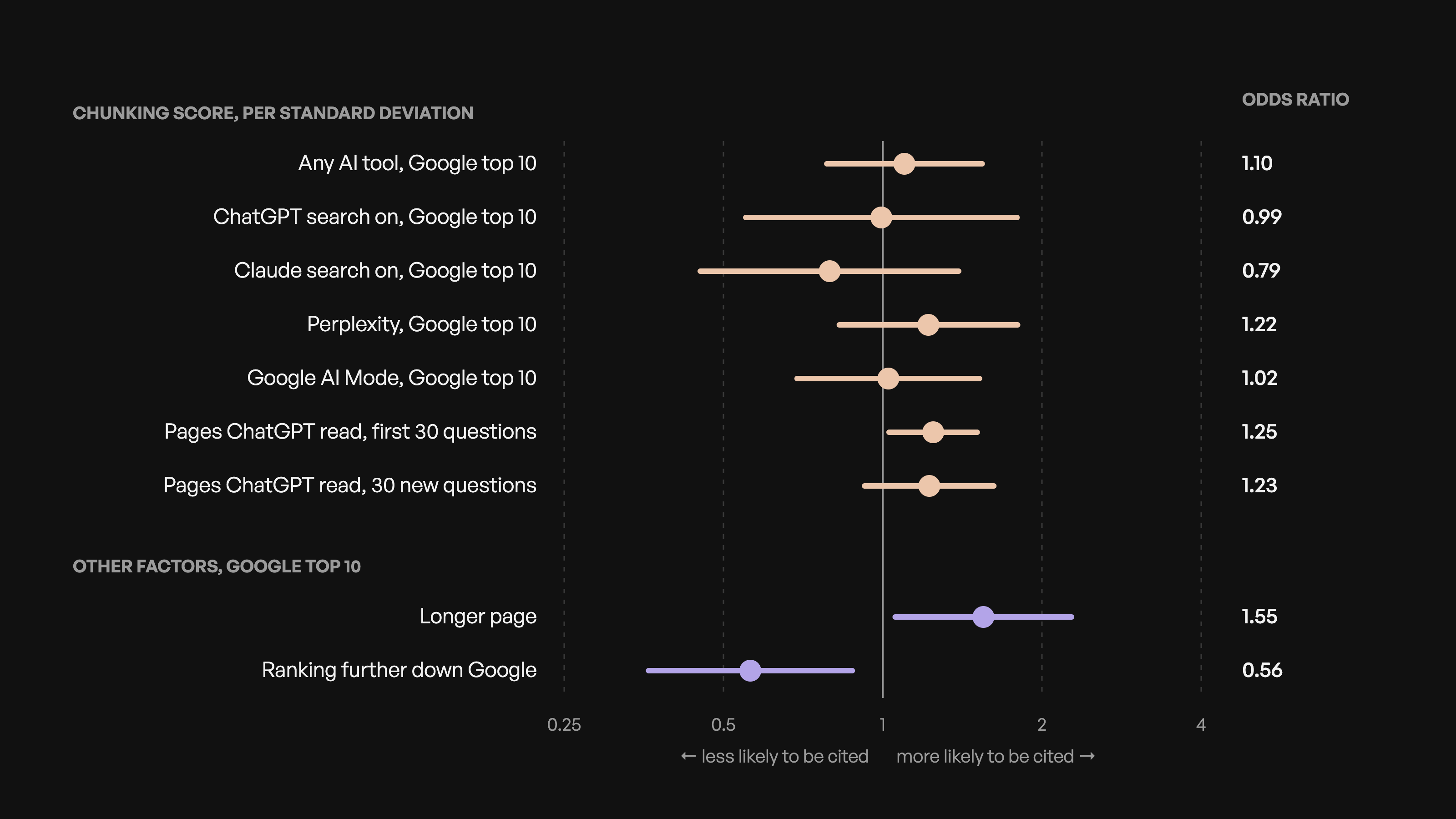
The chart shows odds ratios. An odds ratio of 1 means a factor made no difference to whether a page was cited, above 1 means it made a page more likely to be cited, and below 1 means less likely. Most of the chunking estimates sit close to 1, with 95% confidence intervals that cross it. Google rank and page length predicted citation much more clearly.
Google's top 10
Before any controls, chunked pages looked favoured: 71% of the top-10 pages an AI tool cited were rated chunked, against 61% of the ones it skipped. The cited pages also ranked higher and were longer, at about 2,250 words against 1,350. Compared with other pages for the same question, with rank and length taken into account, the chunking score no longer predicted citation (odds ratio 1.10, 95% CI 0.78 to 1.54).
No single tool showed a reliable chunking effect. Perplexity leaned slightly positive and Claude slightly negative, but both had wide intervals that cross 1. I also tested each of the five rubric items on its own, and none of them predicted citation.
Pages ChatGPT read
When ChatGPT searched, it read about five pages for every one it cited. Across the 813 pages it read for the first 30 questions, the pages it cited averaged 7.9 out of 10 on chunking and the pages it passed over averaged 7.6 (odds ratio 1.25, 95% CI 1.03 to 1.51). I had the cited and passed-over pages re-scored together in mixed batches, and the result pointed the same way (1.39), so the difference doesn't come from how the batches were scored.
The result is fragile, though. Most of it comes from comparing pages on the same site. On canada.ca, the pages ChatGPT cited scored 7.9 and the pages it passed over scored 6.4, and many of those passed-over pages were index pages that list links to other pages. Without canada.ca, the odds ratio drops to 1.14 and is no longer significant. It also falls short of significance when each page is compared only with pages of the same type, when only articles and guides are counted, or when pages from the same site are treated as related. An earlier version of this comparison, using a random sample of the pages ChatGPT passed over, showed no lean at all (0.95).
Replication on 30 new questions
To check the ChatGPT result, I asked ChatGPT 30 new questions in the same three areas and scored the pages it read the same way: 405 pages, 97 of them cited. The cited pages again scored slightly higher (7.8 against 7.5), and the odds ratio was close to the first round at 1.23 (95% CI 0.92 to 1.62, p = 0.16). By the standard I set before collecting the answers, that's the same direction but not a confirmation.
This time the lean didn't depend on canada.ca (1.21 without it). Only one rubric item, one topic per section, reached significance on its own (1.38), and with seven separate item tests that could easily be chance. The replication was also small: even if the first-round effect is real, it had only about a one-in-three chance of producing a significant result. Combining both rounds gives 1.24 (p = 0.008), but half of that data is the first round, so it isn't independent confirmation.
How each tool finds its sources
The four tools cite from very different pools of pages, and that shaped what got cited more than how a page was written. Google AI Mode leaned on Google's own top 10, while ChatGPT and especially Claude mostly cited pages that weren't on page one.
| Tool | Answers that searched the web | Pages cited per answer |
|---|---|---|
| Perplexity Pro | 100% | 13.7 |
| Claude, search on | 100% | 7.8 |
| Google AI Mode | 78% | 5.0 |
| ChatGPT, search on | 100% | 4.2 |
| Claude (default) | 37% | 2.0 |
| ChatGPT (default) | 42% | 1.1 |
Left to their defaults, ChatGPT and Claude answered most questions from what they already knew, with no citations at all. Google AI Mode cited no outside pages for several personal finance questions, including the TFSA, RRSP, emergency fund and lease-or-buy questions. Answers were often tailored to Victoria and Langford, BC, even with memory and personalisation off, because the tools read the location from the connection.
Examples
Some of the most-cited pages in the study scored lowest on chunking, and some of the best-chunked pages ranked first in Google and were never cited.
| Question | Page | Google rank | Chunking score | Cited by |
|---|---|---|---|---|
| what should I look for when hiring a contractor | Travelers: checklist for hiring the right contractor | 2 | 1 of 10 | Google AI Mode (both runs), Claude |
| how does a TFSA work | Canada Revenue Agency: Tax-Free Savings Account | 1 | 3 of 10 | ChatGPT (search on, both runs), Perplexity (both runs) |
| how much should I budget for a wedding in Canada | Today's Bride: the ultimate wedding budget breakdown | 7 | 1 of 10 | Google AI Mode |
| what is a good email open rate for ecommerce | Campaign Monitor: what are good email metrics | 1 | 9 of 10 | None |
| what is blended ROAS | Vision Labs: blended ROAS | 1 | 10 of 10 | Google AI Mode (both runs) |
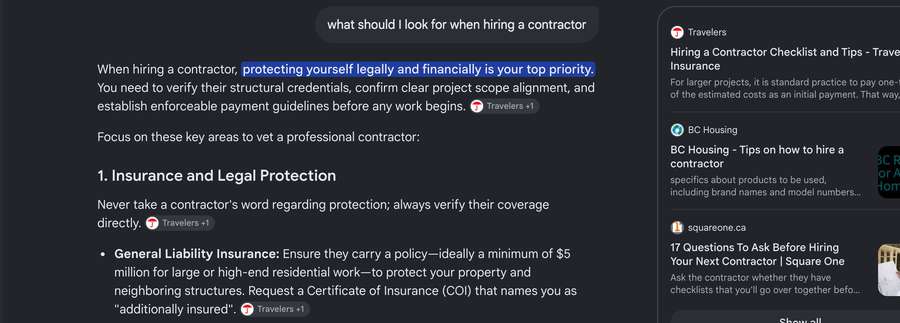
Half of the Travelers page's 1,800 words sit in one unbroken block, and its other headings belong to the site's menus. Google AI Mode still built its whole answer on that page, citing it after almost every paragraph. The cited pages tended to rank well and come from established sites on the topic, whatever their structure.
What this means
- Rewriting pages into chunks is unlikely, on its own, to get them cited by AI search. Getting found in the first place counts for more.
- For Google AI Mode, rank matters most. More than half of what it cites comes from Google's own top 10, so ordinary SEO is the most direct route into its answers.
- ChatGPT and Claude mostly cite pages outside Google's page one, so check where each tool finds sources for your topics before assuming your Google rank carries over.
- Longer, more thorough pages were cited more often, even after rank was taken into account.
- About 60% of the pages I scored were already chunked, so chunking no longer sets a page apart, although it still makes a page easier for people to read.
- This study can't rule out a small effect, especially for ChatGPT. If chunking matters to you, test it on your own site by rewriting some pages and comparing them with similar pages you leave alone.
Limitations
- Observational. The study shows chunked pages weren't cited more often. It can't prove chunking has no effect.
- Sample size. 60 questions and about 1,400 scored pages can detect a large effect but could miss a small one. The replication had about a one-in-three chance of confirming an effect the size of the first ChatGPT result.
- Scope. The top-10 comparison covers only pages in Google's top 10. About 790 pages that Claude, Perplexity or Google AI Mode cited from outside the top 10 weren't scored.
- Profiles, not full pages. The scorers saw headings, section lengths and opening sentences, not the full text. FAQ answers hidden behind accordions read as empty, so some FAQ-heavy pages may look more chunked than they are.
- AI scorers. The pages were scored by AI agents working from a written rubric. Two scorers agreed on 88.5% of labels in the first round, and two different AI models agreed on 82% in the replication.
- A broad definition of cited. Perplexity's full sources list and Google AI Mode's sources panel count as cited.
- One location. Everything ran from Victoria, BC, so answers and sources lean Canadian, especially for cost questions.
- A snapshot. The answers were collected on November 6 and 7, 2026, and AI tools often change how they find sources.
Study data
Download the scored pages (CSV), with one row per question and page: the round, the question, the page URL, its Google rank, which tools cited it, whether ChatGPT read it without citing it, its word count and its five rubric scores.
Methodology
Conrad Studio original research. The main answers were collected on November 6 and 7, 2026, and the ChatGPT replication on November 7, 2026.
Questions
30 everyday questions, 10 in each of three areas: home services ("how often should a furnace be serviced"), B2B SaaS and ecommerce marketing ("what is blended ROAS") and personal finance and travel ("how does a TFSA work"). I left out "best company" questions, because AI answers to those mostly cite directories.
Tools
Each question was asked twice in each of six setups, for 360 answers in all.
| Tool | Setup |
|---|---|
| ChatGPT | Temporary chat set to Unpersonalized, default settings, so it searched the web only when it decided to |
| ChatGPT, search on | The same, with web search switched on |
| Claude | Incognito chat, default settings |
| Claude, search on | Incognito chat, with "Search the web:" at the start of the question |
| Perplexity Pro | Default search, with memory switched off |
| Google AI Mode | Signed in, with Personalize Search switched off |
All the tools were used from the same Chrome browser in Victoria, BC. Every answer was saved word for word with a checksum, and a screenshot was taken at the time it was collected. For Perplexity I counted every page in its sources list as cited, and for Google AI Mode every page in its sources panel, which is a wider definition than the links inside the answer.
Pages
For each question I kept Google's organic top 10 and every page ChatGPT read while answering. ChatGPT's conversation data lists the pages it opened, including the ones it didn't cite. That gave two fair comparisons: top-10 pages the AI tools cited against top-10 pages they skipped, and pages ChatGPT read and cited against pages it read and passed over.
994 pages had enough text to score (100 words or more). Reddit, forums, social media, YouTube and PDFs were left out. To keep the job a manageable size, I didn't score the roughly 790 pages that Claude, Perplexity or Google AI Mode cited from outside Google's top 10.
Chunking score
A script recorded each page's headings, the length of each section and its opening sentences. A scorer who didn't know whether the page had been cited, or which site it came from, rated it 0 to 2 on five items:
- Each heading says what its section answers.
- The answer comes first in each section.
- Each section makes sense on its own.
- Each section sticks to one topic.
- Sections are short enough to quote.
The total out of 10 gives a label: chunked (8 to 10), partly chunked (4 to 7) or not chunked (0 to 3). The scorers were AI agents working from the same written rubric. A second scorer re-rated 139 pages (21%) without seeing the first scores, and the two agreed on 88.5% of labels (Cohen's kappa 0.76). Every disagreement was between chunked and partly chunked.
Analysis
Each page was compared only with the other pages for the same question (conditional logistic regression grouped by question), with Google rank and page length as controls. Results are odds ratios per standard deviation of the chunking score, which is about 2 points out of 10. An independent checker recomputed every number from the raw files.
Replication
To test the ChatGPT result, I asked ChatGPT 30 new questions in the same three areas, once each, with web search on in an Unpersonalized temporary chat. Before collecting any answers, I wrote down the analysis and the result that would count as a confirmation: an odds ratio above 1 with p below 0.05.
I scored all 104 pages ChatGPT cited and a random 346 of the 441 pages it read without citing, and 405 of them had enough text to score. The pages were scored by the same AI model as the first round. A different AI model also scored all 405 as a check, and the two agreed on 82% of labels (kappa 0.64). On those scores the result pointed the same way and was smaller (odds ratio 1.15). Two more independent checkers reproduced the result from the raw files.

Research by Aliya Conrad





let’s Work together