Does hiding your pricing cost you in AI answers?
I asked ChatGPT, Perplexity and Google AI Mode 448 pricing questions about 30 SaaS products. Hidden prices still got quoted, from other sites.
Key findings
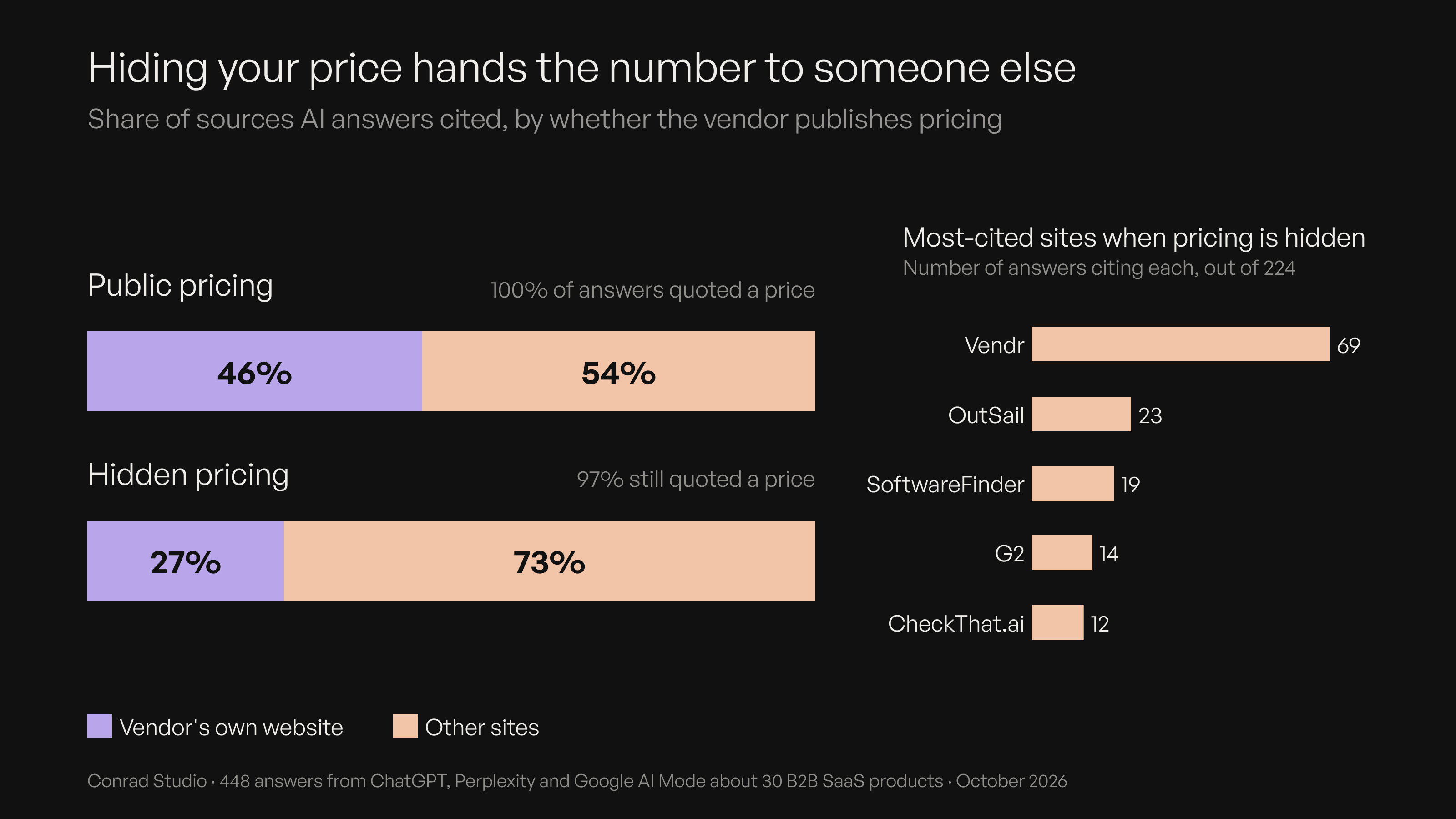
Hiding your pricing costs you control of the number buyers see. For products that don't list prices on their website, AI tools still quoted a price in 97% of answers, but those prices came from Vendr, review sites and competitors' blogs instead of the vendor.
- Hiding your price doesn't stop AI tools from quoting one. 218 of 224 answers about products with no published pricing (97%) still gave the buyer a dollar figure.
- Those numbers come from someone else. Only 27% of the sources cited for hidden-pricing products were the vendor's own website, compared with 46% for public pricing.
- Public pricing was quoted correctly 73% of the time. 21% of those answers included at least one outdated price.
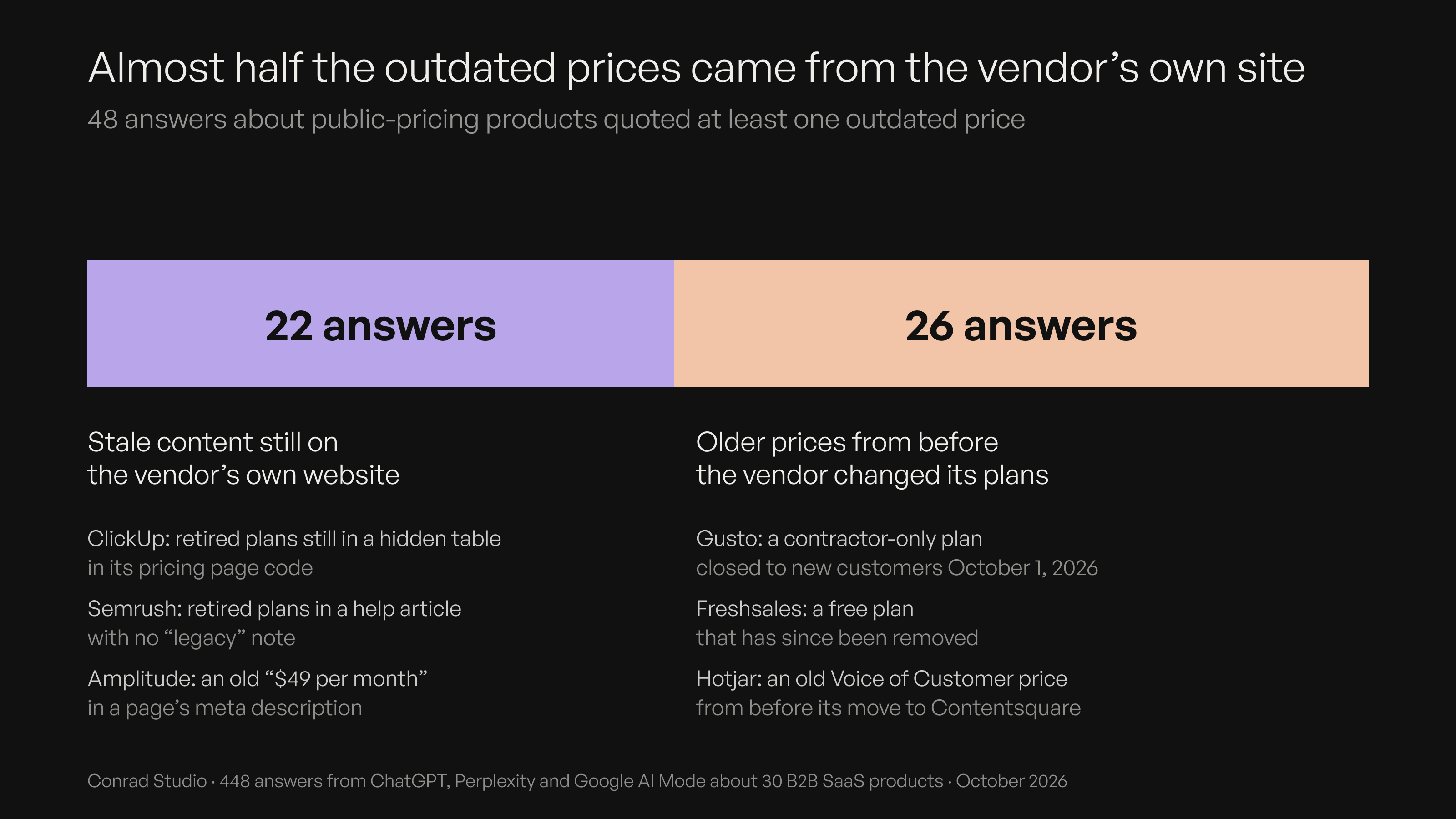
- Nearly half of the outdated answers (22 of 48) came from the vendor's own website, such as old help articles, retired pricing tables and meta descriptions.
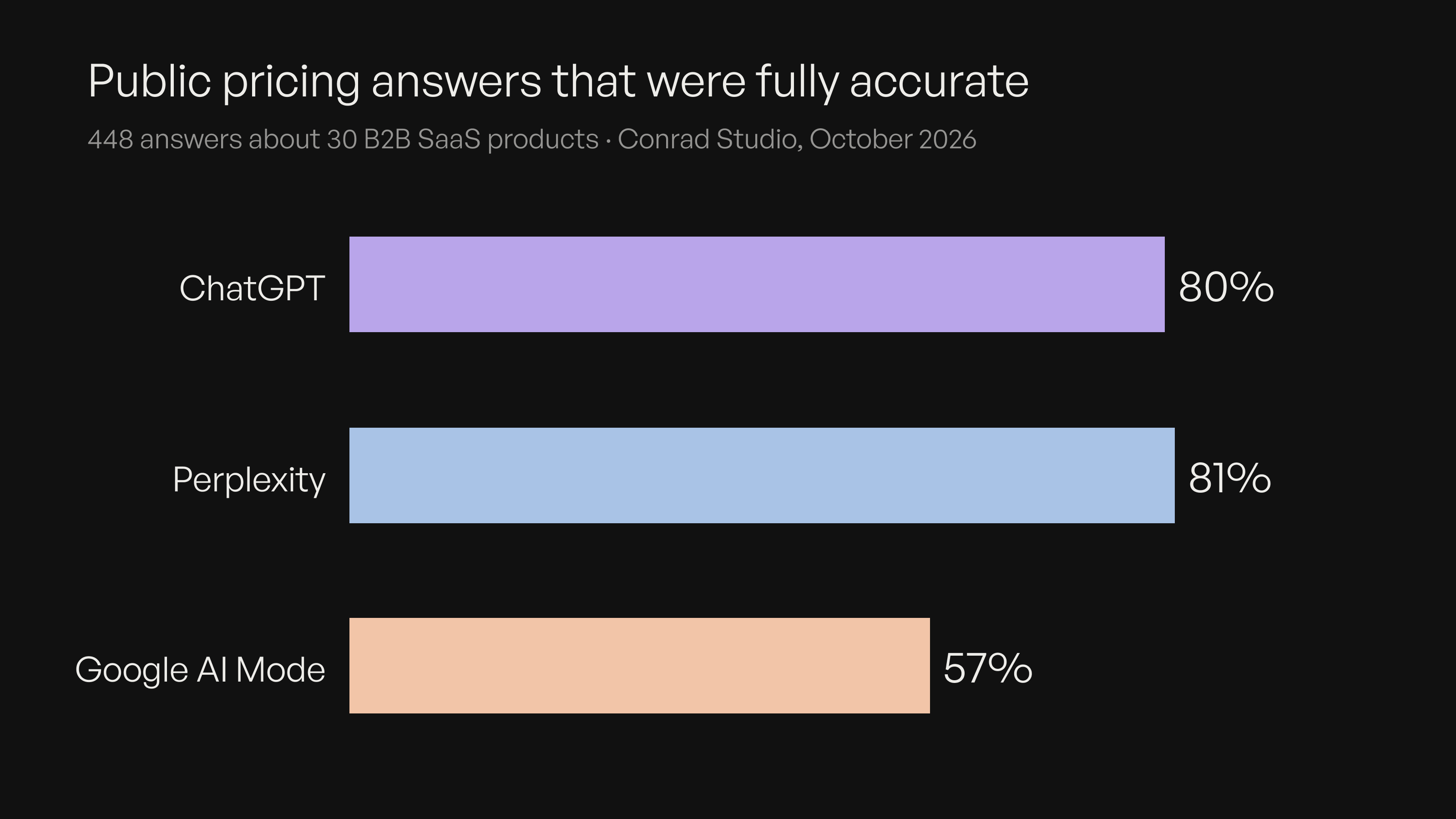
- Google AI Mode was the least accurate on public pricing: 57% fully accurate, compared with 80% for ChatGPT and 81% for Perplexity.
Results
448 answers were scored: 150 from Perplexity, 150 from Google AI Mode and 148 from ChatGPT (2 ChatGPT answers were lost; see Limitations).
Public vs hidden pricing
| Public pricing (224 answers) | Hidden pricing (224 answers) | |
|---|---|---|
| Accurate (public) or honest that prices are estimates (hidden)* | 163 (73%) | 222 (99%) |
| Outdated | 48 (21%) | n/a |
| Wrong plan | 3 (1%) | n/a |
| Made up | 10 (4%) | n/a |
| Estimate stated as fact | n/a | 1 (0.4%) |
| Doesn't know | 0 | 1 (0.4%) |
| Gave at least one dollar figure | 224 (100%) | 218 (97%) |
| Cited the vendor's own website | 217 (97%) | 173 (77%) |
| Share of cited sources that were the vendor's site | 46% | 27% |
| Vendor's site anywhere in the sources shown or searched | 218 (97%) | 194 (87%) |
*For hidden-pricing products, there's no official price to check the numbers against, so this row measures whether the answer was honest that pricing isn't published and labelled its figures as estimates. It doesn't mean the figures were right, and it doesn't mean hidden pricing leads to more accurate answers. What it shows is that buyers still get a number, and that number comes from third parties. For the same reason, outdated, wrong plan and made up don't apply to hidden-pricing products.
The AI tools were mostly upfront about this. 94% of answers about hidden-pricing products (211 of 224) said the vendor doesn't publish prices, and only 1 of 224 presented an estimate as if it were the vendor's list price.
By AI tool
| ChatGPT | Perplexity | Google AI Mode | |
|---|---|---|---|
| Public pricing: fully accurate | 59/74 (80%) | 61/75 (81%) | 43/75 (57%) |
| Public pricing: outdated | 12 (16%) | 13 (17%) | 23 (31%) |
| Public pricing: made up or wrong plan | 3 (4%) | 1 (1%) | 9 (12%) |
| Hidden pricing: gave a figure anyway | 72/74 (97%) | 71/75 (95%) | 75/75 (100%) |
| Hidden pricing: cited the vendor's site | 63/74 (85%) | 53/75 (71%) | 57/75 (76%) |
Where AI tools get prices when you don't publish them
These were the most-cited non-vendor sites in answers about hidden-pricing products, with the number of answers citing each: Vendr (69), OutSail (23), SoftwareFinder (19), G2 (14), CheckThat.ai (12), Agileday (10), Reoptimize.ai (9), Claap (9), VendorBenchmark (9), Woodpecker (9), PortfolioHub (9), Outdoo (9), CostBench (8), UserInsight (8) and Avoma (8).
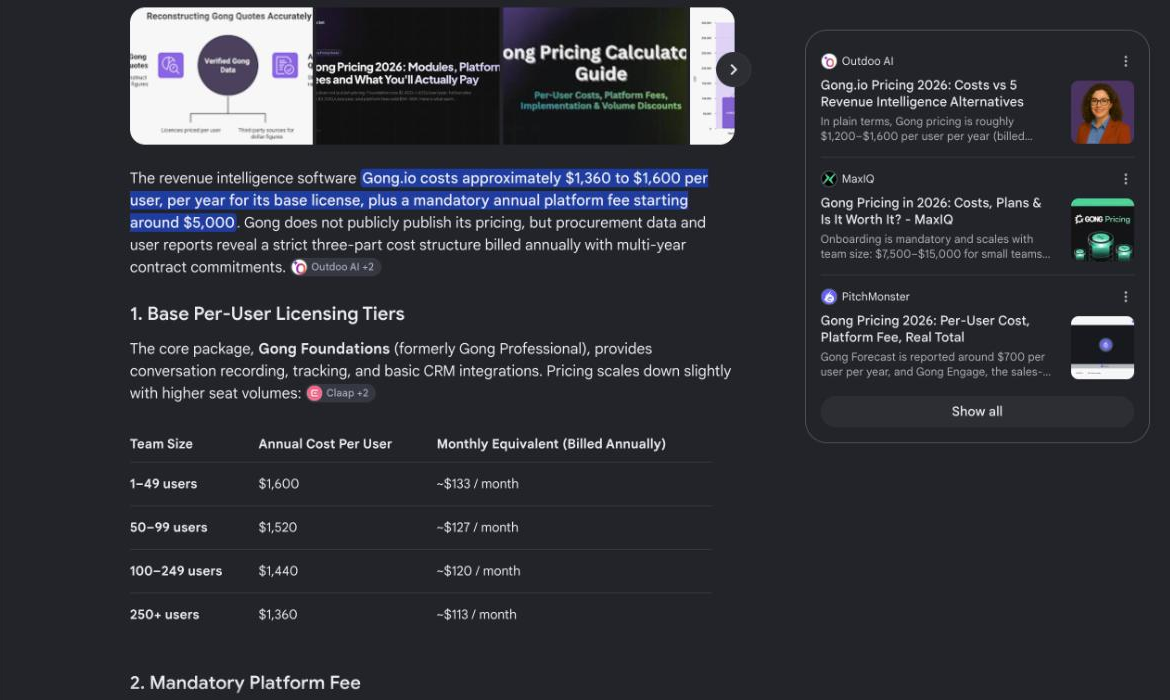
Many of these are competitors' blogs (Claap, Outdoo and Avoma all write about Gong pricing, for example) or software marketplaces. Asked "How much does Gong cost?", Google AI Mode cited only competitors' pricing articles, built a volume-discount table that Gong doesn't publish, and showed a Gong ad underneath.

Why public-pricing answers went wrong
Outdated (48 answers). The biggest sources were:
- ClickUp (14 of 14 answers): retired Unlimited and Business plans, which are still in a hidden table in ClickUp's own pricing page code.
- Gusto (8): a contractor-only plan that closed to new customers on October 1, 2026.
- Freshsales (7): a free plan that has been removed.
- Hotjar (7): an old Voice of Customer starting price from before Hotjar's pricing moved to Contentsquare.
- Semrush (6): the retired Guru and Business plans, which Semrush's own help centre still lists with no "legacy" note.
- Deel (3), Amplitude (2) and Pipedrive (1).
22 of the 48 outdated answers can be traced to stale content still on the vendor's own website, including an old "$49 per month" in the meta description of an Amplitude page.
Made up (10 answers). 3 were arithmetic mistakes in 20-person totals with correct inputs (Ahrefs, Semrush and Asana). 6 involved usage-priced products (Mixpanel and Amplitude), where answers gave event-volume prices that don't match the vendor's calculator. 1 gave a BambooHR range whose upper end ($400) matches no plan.
Wrong plan (3 answers). Monthly and annual prices were mixed up, or a usage overage rate was presented as a plan price.
Other findings
- Consistency: when the same question was asked again in a fresh session, the answer got the same label 89% of the time (159 of 179 groups of repeats).
- Ads: Google showed a Sponsored block next to 117 of 150 AI Mode answers (78%). Many were from competitors, such as Ziflow advertising "Workfront being discontinued" on Workfront queries, and WalkMe and Userpilot on Pendo queries. Some vendors advertised on their own price queries (Gong, Close and Outreach).
- Location: answers were tailored to Canada even though no location was mentioned. Answers quoted BambooHR's Canadian page (CA$14.40 per employee), Pipedrive's Canadian price points, ADP Canada and CAD conversions. A buyer in another country could get different numbers.
- Same-name products: 15 answers mixed in other products with the same name (Conductor.build and the Botify AI chatbot). Two Perplexity answers priced only the wrong Conductor.
- "Hidden" isn't always hidden: one ChatGPT answer found Planview's own AWS Marketplace listings (ProjectPlace at $240 per user per year), so a vendor that keeps prices off its website can still publish them somewhere AI tools look.
What this means
- Not publishing a price doesn't keep a number out of the conversation. It hands the number to Vendr, review sites and competitors' blogs.
- The AI tools mostly labelled those numbers as estimates, but a buyer still walks away with a budget figure the vendor didn't choose.
- Publishing prices isn't enough on its own. Old prices in help articles, old pages and even hidden page code get picked up and repeated, so retire old pricing everywhere, not just on the pricing page.
- Usage-based pricing was the hardest for AI tools to get right. If your pricing is a calculator, publish a few worked examples in plain text.
Limitations
- One day, one location, one set of accounts. Answers change over time and by country, and all three tools localised to Canada.
- Citation counts are approximate. Perplexity sometimes shows a source as a small label without a link the study could capture. 15 such vendor labels were counted by hand, and others may have been missed.
- Small numbers per product. 30 products and 5 answers per product per tool, so treat percentages as directional. The 95% confidence interval for public-pricing accuracy is roughly 67% to 78%.
- Hidden and public products differ in more than pricing. The hidden group skews enterprise, so these comparisons aren't controlled experiments.
- Estimates can't be checked. For hidden-pricing products there is no official price, so the study measures how answers frame their numbers, not whether those numbers are right.
- Some prices couldn't be observed. Pipedrive's and monday.com's US monthly-billed prices aren't visible from either location the study used, so those figures were marked unverifiable rather than right or wrong.
- ChatGPT text completeness. ChatGPT sometimes splits an answer into two messages, and the first capture kept only the last one. Re-fetching recovered the full text for 73 conversations, but 77 temporary chats had already been deleted by ChatGPT. Of those, earlier text was recovered for 9, 53 are probably complete, and 13 are probably missing their opening paragraph. Results with those 13 excluded are essentially unchanged (ChatGPT public accuracy 79% vs 80%). 2 ChatGPT answers were lost entirely.
- Product changes before querying. BambooHR turned out to publish prices now, so it moved to the public group. Rippling shows prices only to US visitors and Contentsquare now publishes prices on a page it shares with Hotjar, so both were dropped. Justworks was dropped to keep HR balanced, and Workday HCM, ADP Workforce Now and Adobe Analytics were added. Clari's website now redirects to Salesloft's sales page.
- Rulings during scoring. Ten written rulings clarified edge cases, such as prices visible only in images, collapsed FAQs and approximate figures within 3%.
Study data
Download the full dataset (CSV). It has one row per answer: the AI tool, product, question, label, headline figure, cited sources, claim-by-claim verdicts, scorer notes and the full answer text.
The study archive (protocols, scoring rulings, ground-truth captures, raw answers with checksums and analysis scripts) is available on request. Email aliya@conrad.studio.
Methodology
Conrad Studio original research. All data was collected on October 22, 2026.
Products
30 B2B SaaS products across 5 categories, with 3 public-pricing and 3 "contact sales" products in each. A product counted as public if its own website published a price for at least one paid plan, and hidden if it published no price for any paid plan. Each product's status was confirmed on its own website on the test date.
| Category | Public pricing | Hidden pricing (contact sales) |
|---|---|---|
| CRM & sales | Pipedrive, Close CRM, Freshsales | Gong, Outreach, Clari |
| SEO & marketing | Semrush, Ahrefs, Moz Pro | BrightEdge, Conductor, Botify |
| Project & work management | Asana, monday.com, ClickUp | Adobe Workfront, Planview, Kantata |
| HR & payroll | Gusto, Deel, BambooHR | Paylocity, Workday HCM, ADP Workforce Now |
| Product analytics | Mixpanel, Amplitude, Hotjar | Fullstory, Pendo, Adobe Analytics |
Before any questions were asked, three products were replaced and one moved groups because they didn't match what was expected (details under Limitations).
Questions and tools
Each AI tool was asked the same two questions about every product, in a fresh session each time:
- Q1: "How much does [product] cost?" (asked 3 times)
- Q2: "How much would [product] cost for a team of 20 people?" (asked 2 times)
That's 5 answers per product per tool, or 450 planned answers. Repeats were spread out over the day rather than asked back to back.
- ChatGPT: logged-in workspace account, temporary chat, "Unpersonalized" (ignores memory and custom instructions), default model (reported as gpt-6, "Instant"). It searched the web on every answer.
- Perplexity: Pro account, default Search mode and "Best" model. The free plan hit its search limit after about 10 searches, so those answers were set aside and every Perplexity answer was collected again on Pro.
- Google AI Mode: signed-in Google account.
All three were used from the same Chrome browser in Vancouver, Canada, which affected some answers (see Limitations).
Ground truth
For every product, the vendor's pricing page was captured on the test date in Chrome, cross-checked from a US location, and compared with archived versions from 2024 and 2025 so outdated prices could be identified. Every captured page and every AI answer was saved with a checksum, and each saved file was verified against it.
Scoring
Every dollar figure in every answer was checked against the ground truth, then each answer got one label:
- Accurate: every checkable price is right. For hidden-pricing products, the answer says pricing isn't public and clearly presents any figures as estimates or third-party data.
- Outdated: at least one price the vendor used to charge but doesn't now.
- Wrong plan: a real current price attached to the wrong plan, billing period or unit.
- Made up: at least one price that matches nothing the vendor has published, now or in archived versions. Arithmetic mistakes are counted here but flagged separately.
- Doesn't know: no figures and no useful answer.
- Estimate stated as fact (hidden-pricing products only): a third-party figure presented as if it were the vendor's own price.
A second scorer independently re-scored a random 96 answers without seeing the first scores. They agreed on 95 of 96 labels (99%, Cohen's kappa 0.95), and the one disagreement was settled using the written rules. A separate checker then recomputed every number in this report from the raw files and spot-checked 12 more scores.

Research by Aliya Conrad