Building off-site authority: why it matters for AI search
Your website is only one voice in the conversation. Before an AI tool recommends you, it looks for other sources that agree. Here's which ones matter most for B2B companies and how to start building them.

TL;DR
- AI tools look for agreement across the web before recommending a brand, so what others say about you carries a lot of weight.
- Brand mentions, especially on YouTube, track more closely with AI visibility than backlinks do.
- Brands with even a handful of reviews on a platform like Trustpilot were cited far more often than brands with none.
- Each AI tool leans on different sources, so one big placement won't cover you everywhere.
- Start by finding the sources AI tools already cite for your buyers' questions, then work on getting mentioned there.
A lot of the teams I talk to are surprised by this: you can have a great website and solid SEO, and still not show up when a buyer asks ChatGPT who to look at.
AI tools don't just take your website's word for it. Before they recommend a brand, they look for other sources that back it up, like review sites, articles, videos and the places your buyers hang out. That's what I mean by off-site authority, and it's a big part of whether you show up.
Say someone asks, “What's the best accounting software for a 30-person construction company?” The tools that get named are usually the ones with reviews on G2, mentions in comparison articles and a few industry blogs talking about them. The nicest website doesn't always win.
What is off-site authority?
It's basically everything said about your brand on sites you don't own. That includes:
- Reviews on platforms like G2, Capterra and Trustpilot
- Mentions in articles, roundups and comparison posts
- Podcast, video and webinar appearances
- Partner, integration and marketplace listings
- LinkedIn posts and community discussions
If you've done SEO for a while, you're probably thinking “so, backlinks?” Kind of. Backlinks are part of it, but for AI tools a mention without a link can still count. What matters is that other credible sources are talking about you, and saying the same things you say about yourself.
Why does off-site authority matter so much in AI search?
AI tools really don't want to recommend the wrong company. So instead of trusting one site's claims about itself, they look for agreement across a bunch of sources. If your website says you're the best fit for construction firms and nobody else mentions you, that's a weak signal. If reviews, articles and a couple of industry podcasts say the same thing, it's a lot more convincing.

The data lines up with this. Ahrefs looked at about 75,000 brands and found that brand mentions tracked much more closely with AI visibility than backlinks did. YouTube mentions had the strongest relationship of anything they measured, with a correlation of about 0.74, and mentions across the web were close behind. Backlinks only showed a weak relationship.
That's a correlation, not proof, and strong brands tend to have all of these things at once. It's still a good sign of where to put your effort.
I think of it like this: your own site is how AI tools understand what you do, and off-site sources are how they decide whether to trust it. I talk more about the on-site side in SEO vs GEO.
Which off-site sources matter most for B2B companies?
Not every mention is worth chasing. These are the ones I'd focus on for a B2B company:
- Review platforms: G2, Capterra, Trustpilot, or whichever one your buyers actually check. More on these below.
- Third-party lists and comparison articles: the “best tools for…” roundups that keep showing up in AI answers. I dig into whether they're worth it in Are listicles worth it for AI visibility?
- Industry publications, newsletters and podcasts: the places your buyers already learn from.
- YouTube: demos, walkthroughs and customer stories. Given the Ahrefs data, this one's easy to underestimate.
- LinkedIn: posts and articles from your founders and experts, not just the company page.
- Partner and integration directories: B2B buyers check these to make sure you work with the tools they already use.
- Communities: forums, Slack groups and Reddit, etc.
Communities can matter, but they can also disappear overnight. Promptwatch tracked Reddit's share of ChatGPT citations dropping from about 3.8% to about 0.5% in August 2026, after ChatGPT changed how it searches. So I wouldn't build your whole strategy around any one platform.
Do reviews affect whether AI tools recommend you?
A lot more than most people expect. In a Seer Interactive study of more than 800,000 AI responses, brands with no Trustpilot profile had a median citation rate of 1%. Brands with just 1 to 13 reviews were at 53.5%. That's a huge jump for a pretty small number of reviews.

Reviews also matter more the closer someone is to buying. In the same study, review sites made up about 1.5% of citations when people were asking early, general questions, and about 24% when they were close to a decision. So when someone asks “is [your company] worth it?” or “[you] vs. [competitor],” your reviews are a big part of the answer.
One caveat: the study focused on Trustpilot, Trustpilot promoted the results, and it's a correlation. Still, it matches what I'd expect. AI tools want proof that real customers use you.
You don't need hundreds of reviews to start. A few things that make it easier:
- Ask at natural moments, like after onboarding, after a big win or at renewal.
- Send a direct link so it takes a couple of minutes, not twenty.
- Focus on the platform your buyers check, rather than spreading thin across five.
- Follow each platform's rules on incentives, since breaking them can get your reviews removed.
Do all AI tools look at the same sources?
Nope, and this one surprises people. In a Writesonic study of more than 160,000 prompts, about 72% to 73% of the websites cited by ChatGPT, Gemini, Perplexity and Google AI Overviews were only cited by one of them. Just 3.8% got cited by all four.
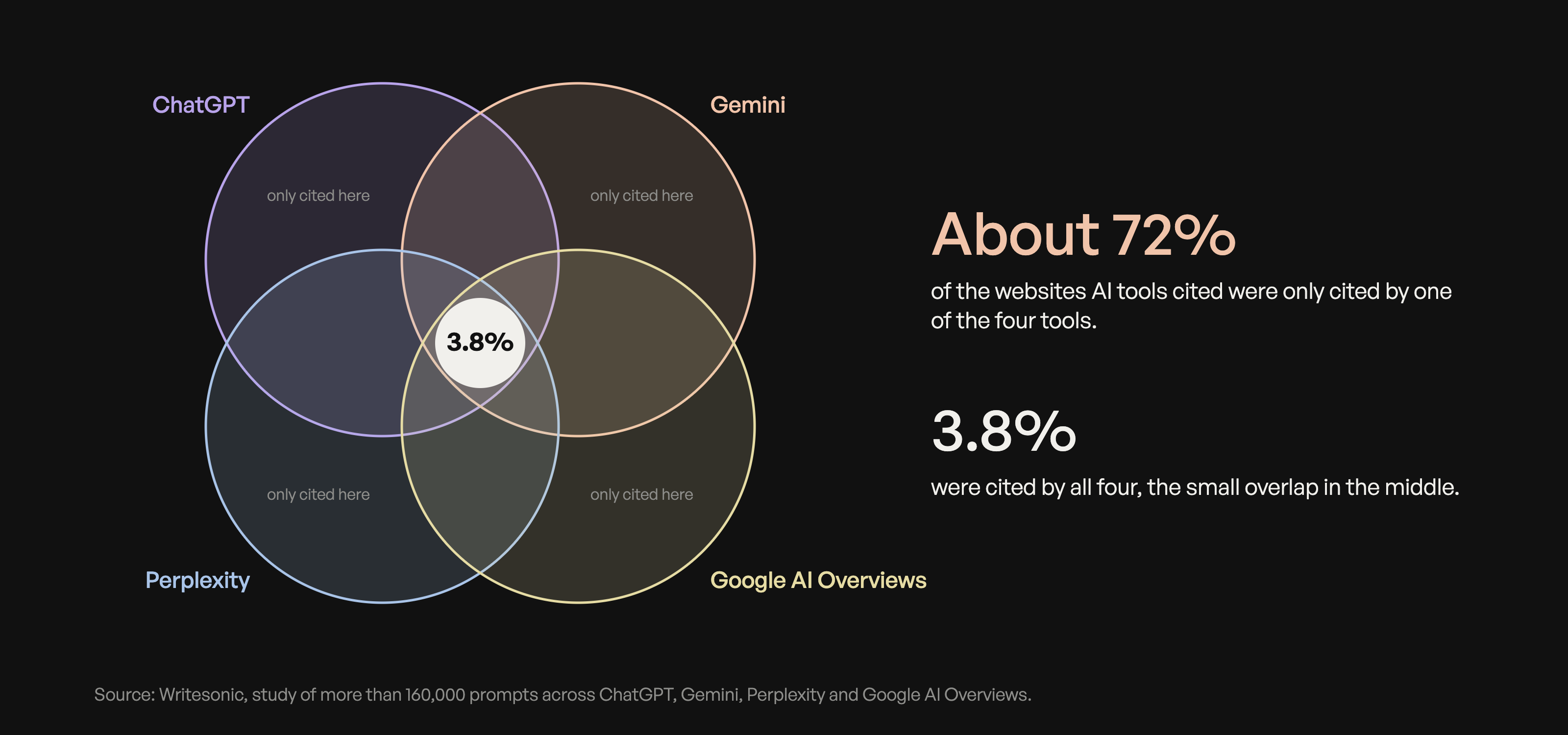
So one big article placement might help you in Perplexity and do nothing in ChatGPT. That's why I'd spread your efforts across a few kinds of sources and check each AI tool separately.
How do you figure out where to build off-site authority?
Start with what AI tools are already citing for your buyers' questions. A lot of teams miss this step, and it saves a lot of wasted effort.
- Write down the questions your buyers ask, with a few different versions of each. Your sales team is the best source for these.
- Run them through ChatGPT, Perplexity and Google's AI Mode.
- Collect the third-party pages that get cited: review sites, articles, lists and videos.
- Note which ones mention your competitors but not you.
- Start with the ones that come up most often.
For example, if the same industry newsletter keeps getting cited for “best scheduling software for clinics,” that's a much better target than a big-name publication that never comes up for your topic.
Then pick the right approach for each one. A review site needs reviews. A newsletter or publication needs a reason to cover you, like useful data or an expert take. A partner directory usually just needs you to fill out the listing properly.
What doesn't work for off-site authority?
A few things I'd steer clear of:
- Fake or paid-for reviews that break platform rules.
- Dropping your brand into forum and Reddit threads. It usually gets removed, and it makes you look worse.
- Paying for placements that aren't labelled as sponsored.
- Chasing high-authority sites that have nothing to do with what your buyers ask.
How do you know if off-site authority is working?
Off-site authority takes a while to build, so look for trends month to month rather than overnight wins. I'd keep an eye on:
- How often AI tools mention you across your groups of buyer questions, and how that compares with your competitors.
- Which third-party sources AI tools cite when they do mention you, and whether that list is growing.
- How many reviews you have and how recent they are.
- Branded searches and what people say when you ask how they heard about you. A bit more on why this matters in my guide to zero-click search.
You might have seen a domain authority score in platforms like Semrush (Authority Score) and Ahrefs (Domain Rating). It’s basically an estimate of how strong your website is, based mostly on how many other sites link to you and how trustworthy those sites are. While this isn’t a score from Google, it can help put a metric on what your backlink profile looks like, and it’s most useful for tracking your own progress over time and comparing yourself with competitors.
Where should a B2B company start?
If you've got a small team, I'd keep it simple and start with three things:
- Get a steady trickle of reviews on the platform your buyers use.
- Get onto the third-party lists and articles AI tools already cite for your buyers' questions.
- Show up in one or two places your buyers learn from, like a podcast, a newsletter or a YouTube walkthrough.
That's a lot more doable than a big PR campaign, aimed right at the sources AI tools are already reading.
Want help figuring out where to show up?
If you're not sure which sources AI tools cite in your category, I can help you find them and build a plan to get your brand mentioned there. As your fractional SEO lead, I can own that work alongside your on-site SEO, including finding and pitching placements. See how I work with in-house teams!

Written by Aliya Conrad


more thoughts