SEO vs GEO
GEO builds on the SEO work you're already doing. Here's what changes when buyers ask AI tools which vendors to consider, and what to do about it.

TL;DR
- GEO (also called AEO) is about getting your brand named in AI answers. It builds on SEO, and pages that rank well on Google are far more likely to get cited.
- Buyers ask AI tools longer, more specific questions, so your site needs to spell out who you're for, what you cost and what you integrate with.
- Put key facts near the top of your pages, keep them current, and earn mentions on review sites and comparison articles.
- Track how often you're mentioned across groups of similar questions rather than where you land in a single answer, and ask new leads how they found you.
GEO, or generative engine optimization, is the work of getting your brand named in answers from ChatGPT, Gemini, Perplexity, Copilot and Google's AI Overviews. You'll also hear it called AEO (answer engine optimization). Both terms describe the same shift, and for a B2B company the question behind them is the same: when a buyer asks an AI tool which vendors to look at, does your name come up?
GEO is part of SEO and depends on the same foundation. What changes is how buyers phrase their questions, how AI tools put answers together, and what you need to measure. I'll walk through how the two compare, what I'd change in your content first, and how to tell whether it's working.
What's the difference between SEO and GEO?
Most of the work overlaps. The differences show up in how each one finds your content, what it rewards on the page, and how you measure the results.
| SEO | GEO | |
|---|---|---|
| How your content gets found | Google crawls and indexes your pages over time, renders JavaScript (eventually), and ranks pages in a list of results. | When a question needs current information, AI tools search the web in the background, read the top results and cite a few. Most AI crawlers can't run JavaScript, so content that loads with it can be invisible to them. |
| What works on your pages | Pages target the keywords people search for and match what they're looking for, so they click through. | Pages answer the full question in plain, specific language, with key facts near the top, descriptive headings and current details. |
| What matters off your site | Backlinks from relevant, trusted sites build authority. | AI tools look for agreement across review sites, comparison articles, industry publications and communities before recommending a brand. |
| How you measure success | Rankings, organic traffic and conversions from search. | How often you're mentioned across groups of prompts, your share of voice against competitors, how accurately you're described, and what buyers tell you when you ask how they found you. |
| Why it's worth investing in | Brings in qualified traffic from people who are already searching for what you sell, and they can convert right on your site. | Gets you onto buyers' shortlists, often before they ever visit your site. AI sends fewer clicks, but those visitors tend to be further along in their decision. |
Is GEO replacing SEO?
No. If your LinkedIn feed looks anything like mine, you’re probably seeing a lot of clickbaity “SEO is dead” posts. The reality is AI tools find most of what they cite by searching in the background, so a page that doesn't rank usually never gets read.
The Search Spot's October 2026 study of 488 product pages from Forbes Cloud 100 companies found that pages ranking on Google's first page for five or more searches were cited regularly by AI tools 76% of the time. Pages below that threshold were cited regularly 10% of the time.
In other words, traditional ranking is still how you get in. If your pages don't show up in search, GEO work on top of them isn't likely to get them cited. Strong SEO (clear positioning, strong site content and authority) is what gets you into the answer, and GEO builds on it.
How big is AI search compared with Google?
Traditional search is still much bigger. Google has said it sees more than 5 trillion searches a year, which works out to more than 13 billion a day.
AI search is now big enough to matter, though. Google said AI Overviews had more than 2 billion monthly users, Reuters reported that the ChatGPT app reached 1 billion monthly active users globally based on Sensor Tower data, and Pew Research Center found that 38% of employed U.S. adults use chatbots for work tasks.
B2B buyers use these tools to compare vendors, summarize options and narrow down a shortlist, so you want to show up in both.
How do buyers search differently in AI tools?
For short, popular searches like “project management software,” not much has changed: the brands that win are still the ones with strong authority, backlinks and a solid technical foundation. The longer, more specific searches are where AI has changed things.
On Google, a buyer might type “project management software for agencies.” In ChatGPT, they're more likely to ask “What's the best project management tool for a 40-person agency that bills hourly and needs a client portal?” On Lenny's Podcast, Ethan Smith of Graphite said ChatGPT questions often run 25 words or more, compared with about six for a Google search.
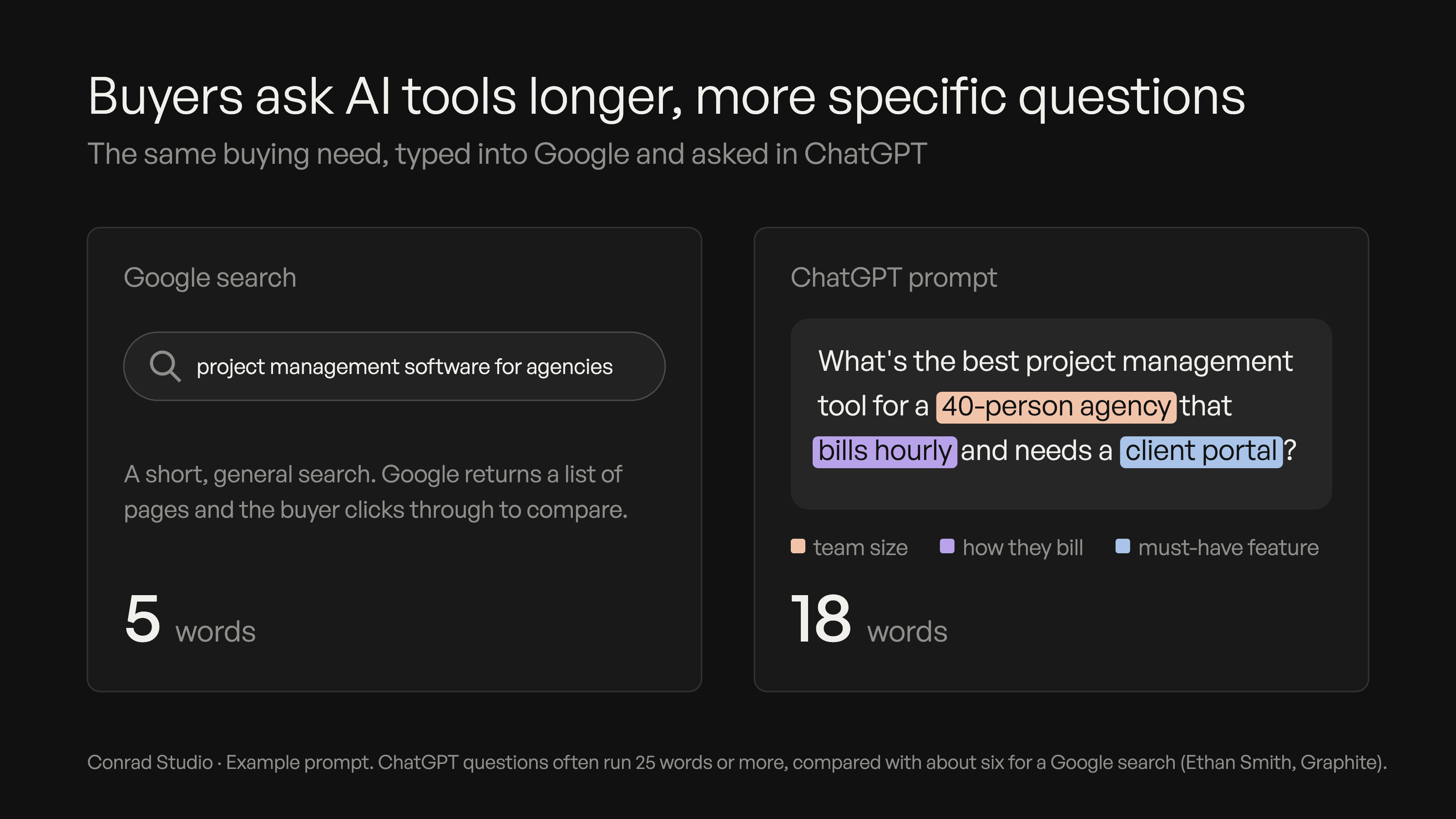
That's roughly four times as long, and the extra words are the buyer's requirements: team size, how they bill clients, the features they can't do without. An AI tool can only match your product to those details if your website spells them out, so a page that just says “project management for agencies” gives it very little to work with.
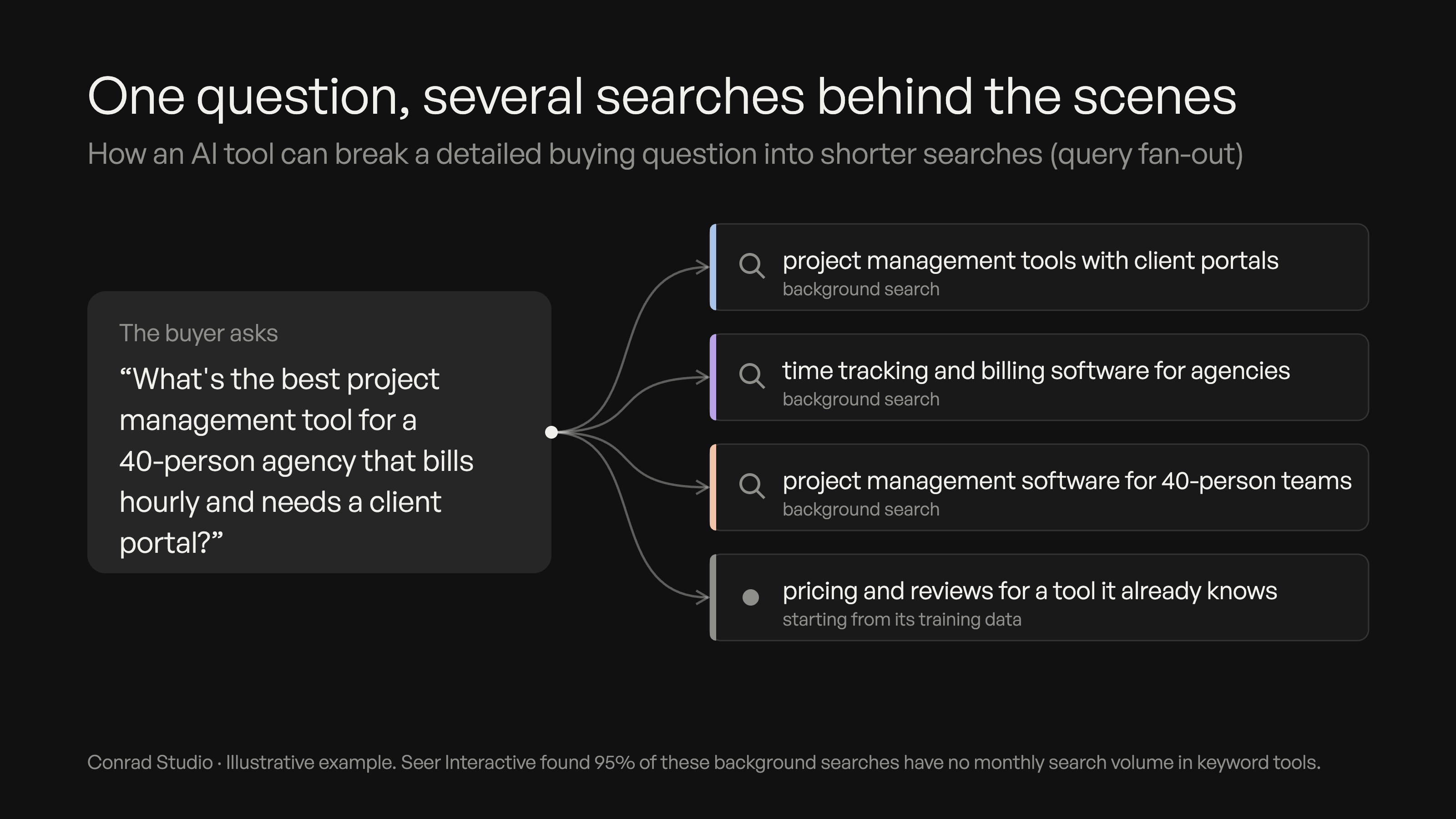
To find pages that match all of those details, AI tools break the question into several shorter searches, a process called “query fan-out”, and run them in the background. For the project management question above, the AI might run separate searches for tools with client portals, for agency time tracking and billing software, and for a vendor it already knows from its training data. Seer Interactive found that 95% of these background searches have no monthly search volume in traditional keyword tools, so keyword research alone won't show you most of what AI tools are looking for.
How do you get your B2B brand recommended in AI answers?
AI tools recommend brands they can clearly match to a buyer's question, and that other sources vouch for. These are the seven things I'd focus on, starting with your own site.
1. Answer the questions buyers ask your sales team
Start with the detailed questions that come up before someone books a demo. Keyword tools won't show you most of them. According to a Semrush study reported in April 2026, 65% to 85% of ChatGPT prompts couldn't be matched to any keyword in Semrush's database, so the best source is your own buyers: sales call recordings, demo notes, support tickets, customer emails and the longer queries in Google Search Console.
Then answer them on the pages buyers already look at. Take your pricing page: it can do much more than list plans, covering what's included in each one, seat or usage limits, contract terms, integrations, security and compliance, how long setup takes, and how you compare with the alternatives buyers are weighing.
That effort pays off. In The Search Spot's study, pricing pages were the most-cited product pages, with a median of 52 citations. If your pricing sits behind a “contact sales” button, AI tools will often fill the gap with whatever third-party sites say. A two-year-old review might list your enterprise plan at $2,000 a month, and that becomes the price buyers hear, even though most of your customers start on a $400 plan. Plenty of companies have good reasons to keep pricing private, and I look at the trade-off in more detail in Does hiding your pricing cost you in AI answers?
2. Put the most important facts near the top of the page
Growth Memo's analysis of 1.2 million AI search results found that 44.2% of ChatGPT citations came from the first 30% of the page. Lead with what the product is, who it's for, what it costs and what it integrates with, before any longer storytelling. If your pricing and integrations only appear after a long brand story, they're sitting in the part of the page AI tools quote least.
Being specific also helps AI tools get your facts right. In an Ahrefs experiment, researchers invented a brand, published an official FAQ on its website and then planted conflicting stories about it elsewhere online. ChatGPT cited the official FAQ in 84% of its answers and rarely repeated the false claims, while Gemini and Perplexity repeated them in more than a third of answers. Ahrefs' takeaway was that detailed sources tend to win over vague ones, so the more plainly your own pages state the facts, the less room there is for someone else's version.
3. Use headings that say what the product does
In The Search Spot's study, product pages with headings that described the product were cited regularly 46% of the time, compared with 25% for pages whose headings promised an outcome. A heading like “Automated invoice matching for Xero and QuickBooks” gives an AI tool something specific to repeat, while “Spend smarter” leaves it guessing what you sell.
4. Build pages for specific use cases
A general features page can only do so much. If you serve different industries, team sizes or use cases, each one may need its own page, such as “accounting software for construction companies” or “CRM for healthcare practices.” Each one should speak to that buyer's situation: their workflows, the tools they already use, the regulations they deal with. Pages that repeat the same copy with a different keyword in the title rarely get cited.
5. Keep key pages up to date
AI tools lean toward current information, especially for details like pricing and features that change often. Seer Interactive's July 2026 study of more than 7,600 AI-cited pages found that 75% had been updated in the past year. That means real updates, like new features, revised pricing tables, new integrations and current screenshots. Changing the date without changing the content doesn't count, btw, and Google's own guidance advises against it.
6. Make sure AI tools can read your site
This is the less glamorous part of SEO, but it matters. AI crawlers add a few requirements of their own. Common problems include robots.txt or firewall rules that block AI search bots, and important content like pricing that only loads with JavaScript. I cover how to check and fix these in my guide to building your site's technical foundation for AI visibility.
7. Earn mentions where AI tools look for second opinions
Everything so far has been about your own site. Before recommending you, AI tools also check whether other sources agree. For B2B companies, that usually means review platforms like G2 and Capterra, “best tools” lists and comparison articles, industry publications, partner and integration directories, podcasts, LinkedIn and YouTube.
To see where to focus, run the questions you want to show up for and look at what gets cited. If the same review sites and comparison articles keep appearing, those are the places to earn a mention. I cover how to do that in more detail in Building off-site authority.
Who should handle AEO/GEO on your team?
There's a lot of noise around GEO right now, with new terms, tools and dashboards appearing every month. In most cases, it's your SEO team, or whoever's already handling SEO for you, because the work builds on what they know: how buyers search, how to structure pages around intent, how to keep a site crawlable and how to build topical authority.
What's new is the set of questions they need to answer. Do AI tools understand what you do? Are they describing you accurately? Which competitors get recommended instead, and which sources are being cited? Whoever owns SEO should own these questions too, with sales and product helping to keep the facts right.
How do you measure GEO results?
AI answers change every time someone asks, so there's no definitive “#1 ranking” like there is in traditional SEO. Showing up as a source (being cited) also isn't the same as being recommended (being mentioned). To see whether your GEO work is paying off, it helps to split your metrics into leading ones, which show progress month to month, and lagging ones, which show whether that progress turns into pipeline.
Track prompt themes instead of single prompts
AI answers change constantly. In a January 2026 study by SparkToro and Gumshoe, the chance of an AI tool returning the same list of brands for the same prompt twice was less than 1 in 100. A screenshot showing your brand at the top of ChatGPT's answer on Tuesday can look completely different when your CEO asks the same question on Wednesday.
What stayed consistent was which brands showed up overall. When the researchers asked many versions of the same question, the strongest brands for that intent appeared in 60% to 90% of answers. So instead of checking where you land in a single answer, track how often you appear across many versions of the question. Group five to eight versions of the same buyer question into a theme, based on what you hear in sales calls, and measure the share of answers that mention you. Tools like Semrush, Ahrefs, Profound, Peec AI and Otterly can automate this.

Know the difference between being cited and being mentioned
Being cited means an AI tool used your page as a source, usually shown as a small footnote link. Being mentioned means it named your brand in the answer itself. You can be cited without being mentioned, for example when an AI tool uses your comparison article to recommend your competitors. A citation shows an AI tool can read your page. A mention shows it's recommending you, and that's the one that matters most.
Leading metrics to watch each month
- Mention rate: how often AI tools name your brand across your prompt themes.
- Share of voice: your mentions compared with your top competitors'.
- Accuracy: whether AI tools describe your pricing, features and compliance correctly. A recommendation that quotes last year's price can still cost you the deal.
- Citations: which of your pages, and which third-party sources, AI tools are pulling from.
Lagging metrics that connect GEO to pipeline
Track demo requests, sign-ups, pipeline and revenue alongside branded search, direct traffic and referral traffic from AI tools. Expect AI referral traffic to look small. A buyer might read ChatGPT's answer, close the tab, type your URL into a new window and book a demo. Your analytics records that as direct traffic, and the AI tool gets no credit. I go deeper on this in my guide to zero-click search.
To see that hidden influence, add “How did you hear about us?” to your demo and contact forms, with ChatGPT, Perplexity and other AI tools as options. It won't be perfect data, but you'll start to see patterns in how people are finding you.
Should B2B companies invest in SEO or GEO?
Both, because they're the same investment. Your authority, technical foundation and brand strength still decide whether you're found. What's changed is the long, specific questions buyers ask AI tools before they decide who to talk to.
The companies that do well here will be the ones whose websites state plainly what they do, who they're for and what they cost, kept up to date and backed up by third-party sources buyers already trust.
Resources
Webflow's interview with Ethan Smith of Graphite is a great overview of how AEO fits with SEO, including the five areas he focuses on for both and where to start.
Google's AI optimization guide is the official word on how its AI search features use your website.
SparkToro's zero-click search study found that only about 36% of US Google searches lead to a click on the open web. It's a good reminder that traffic alone doesn't show how visible you are.
Want your brand to show up in AI answers?
SEO, AEO, GEO, whatever acronym comes next, the goal is the same: help the right buyers find you, understand you, and trust you enough to take the next step.
If your team knows AI search matters but doesn't have the time to work on it, I can help. I work with in-house marketing teams on the research, content and technical fixes that get your site cited in AI answers, either as a one-off project or as ongoing support. The AI search optimization audit is the one-off version, and content strategy is a good fit if you already have writers. See how I work with in-house teams!

Written by Aliya Conrad


more thoughts