Does hiding your pricing cost you in AI answers?
Buyers ask AI tools what software costs whether or not your pricing is public. If it isn't on your site, the answer comes from somewhere else.

TL;DR
- I asked ChatGPT, Perplexity and Google AI Mode about the pricing of 30 SaaS products. When pricing was hidden, they still gave a dollar figure in 97% of answers, mostly from third-party sites.
- Buyers ask AI tools about pricing either way. If your site doesn't answer, AI tools pull from reviews, old articles, forums and third-party estimates.
- Pricing pages are some of the most-cited product pages in AI answers, so leaving yours vague means missing one of your best chances to be cited.
- Your own pages can correct outdated or wrong information, but only if they're specific.
- There are good reasons to keep exact prices private. You can still publish starting prices, ranges and what drives cost.
- Check what AI tools say about your pricing regularly, and treat a wrong answer as something to fix.
Buyers ask AI tools what software costs whether you publish your prices or not. If your website doesn't answer, the AI finds an answer somewhere else, and that answer might be out of date, for the wrong plan, or just a guess.
I asked ChatGPT, Perplexity and Google AI Mode about the pricing of 30 SaaS products, and for the ones with hidden pricing, they quoted a price anyway almost every time. A buyer can rule you out based on that number before they ever talk to your sales team, and you'd never know it happened.
I get why a lot of B2B companies keep pricing behind a “contact sales” button, and I'll get to the good reasons for that. But AI search changes the math a bit, so it's worth looking at what happens when you don't publish.
What happens when a buyer asks an AI tool about your pricing?
AI tools answer questions in two ways. Sometimes they answer from their training data, which is basically a snapshot of the internet from months ago. Other times they search the web live and read whatever comes up.
According to a Semrush study reported by MediaPost, ChatGPT only turned on web search for about 34.5% of queries as of February 2026. So a lot of answers still come from older information, which is how last year's prices stick around long after you've changed them.
When an AI tool does search, it reads what it can find. If your pricing page is clear, that's what it's likely to use. If it isn't, it moves on to other sources.
What I found when I asked AI tools about 30 SaaS products' pricing
I ran a test in October 2026 on 30 B2B SaaS products, 15 with public pricing and 15 with “contact sales.” I asked each tool “How much does [product] cost?” three times and “How much would [product] cost for a team of 20 people?” twice, then checked every dollar figure against the vendor's pricing page and archived versions of it from 2024 and 2025. You can see the full results, methods and data in my study on hidden pricing in AI answers.
- Hiding your price doesn't stop AI tools from quoting one. For products with “contact sales” pricing, they gave a dollar figure in 218 of 224 answers (97%).
- They were mostly upfront about it. 94% of those answers said the vendor doesn't publish its pricing, then quoted estimates from other sites.
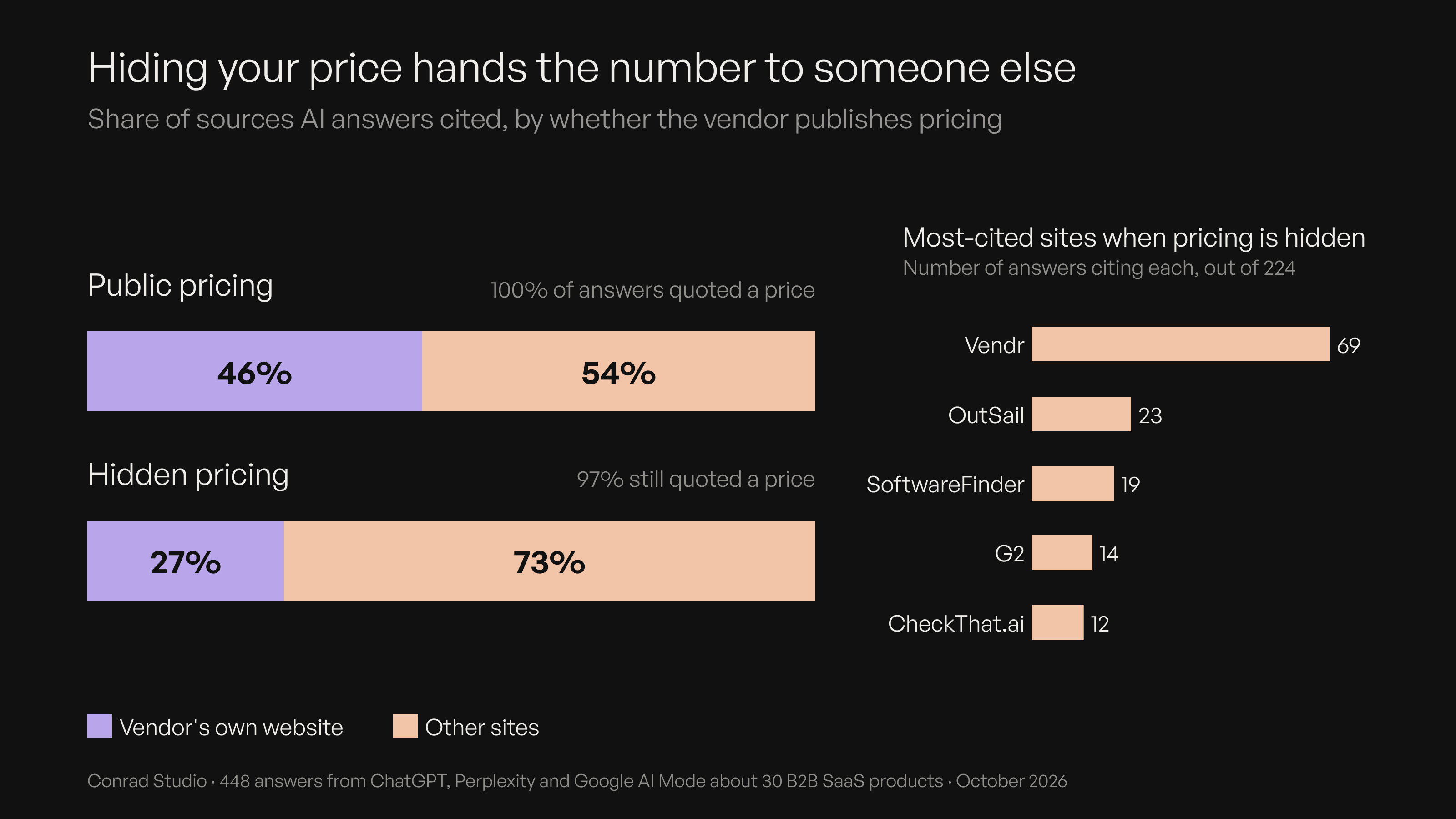
- The numbers came from someone else. Only 27% of the sources cited for hidden-pricing products were the vendor's own website, compared with 46% for products with public pricing.
- Public pricing was quoted correctly most of the time. 73% of answers about public-pricing products were fully accurate, and the most common mistake was an outdated price (21% of answers), usually from a plan the vendor had retired.
Where do AI tools get pricing when you don't publish it?
Pretty much anywhere your price has ever been mentioned:
- Review sites, where customers sometimes mention what they pay
- “Best tools” lists and comparison articles, which often include starting prices. I talk more about these in Are listicles worth it for AI visibility?
- Old blog posts, press coverage and pricing pages that have since changed
- Forum and Reddit threads where someone shared a quote or took a guess
- Third-party estimates
That last one is growing. In August 2025, G2 said only about 4% of its product profiles listed explicit prices, and it started piloting estimated price ranges on profiles instead. In my study, the most cited website for products with hidden pricing was Vendr, a software buying platform that publishes pricing data, which came up in 69 answers. So if you don't publish a number, someone else might publish one for you.
None of these sources know your current plans, your discounts or which package actually fits a 20-person team. Only what got written down somewhere.
Do AI tools actually cite pricing pages?
Yes, a lot. In The Search Spot’s October 2026 study of 488 product pages from Forbes Cloud 100 companies, pricing pages were the most-cited type of product page, with a median of 52 citations each. Even among pages with similar Google rankings, the ones that got cited more than their rankings would have predicted were more than twice as likely to include pricing details (24% compared with 10%). You can still get cited without pricing, since most of those pages didn’t include it, but it seems to give you a leg up.
In the age of AI search, a vague pricing page now costs you more than it used to. It's one of the pages AI tools are most likely to read, and if it doesn't say much, they have nothing useful to quote.
Can your own pages fix wrong pricing in AI answers?
Often, if they're specific enough. Ahrefs ran an experiment where they made up a brand, published an official FAQ on its website, then planted conflicting stories about it on a bunch of other sites. ChatGPT cited the official FAQ in 84% of its answers and rarely repeated the false claims. Gemini and Perplexity were less reliable, repeating the false claims in more than a third of answers.
Ahrefs' takeaway was that detailed sources tend to beat vague ones. It's one made-up brand, so I wouldn't treat it as a rule, but it lines up with what I'd expect: give AI tools a clear, specific answer on your own site and they'll often use it over someone else's guess.
Your own site can also be where a wrong price comes from. In my study, nearly half of the outdated answers (22 of 48) repeated old content still on the vendor's own website, like a help-centre article that still listed retired plans or an old pricing table left in the page code. So when your pricing changes, check your help centre, old blog posts and page descriptions as well as your pricing page.
What do B2B buyers want from your pricing page?
Mostly, they want to know roughly what they're getting into before they book a call. In TrustRadius' 2025 research with more than 2,000 B2B tech buyers, 45% said pricing transparency was the top change they wanted in the buying process.
That's the same question buyers are now asking AI tools. If they can't get an answer from you, they'll take whatever answer they can find.
Are there good reasons to keep pricing private?
Definitely. Plenty of companies have real reasons not to publish a full price list:
- Enterprise deals are custom, so a list price would be misleading.
- Usage-based pricing is hard to sum up in one number.
- Competitors watch your pricing page closely.
- Your sales team wants a conversation to understand what the buyer needs.
Those are all fair, and you don't need to publish every number. But saying nothing has a cost now, so it's worth finding a middle ground.
What can you publish if you can't share exact prices?
You can give buyers (and AI tools) a lot to work with without a full price list:
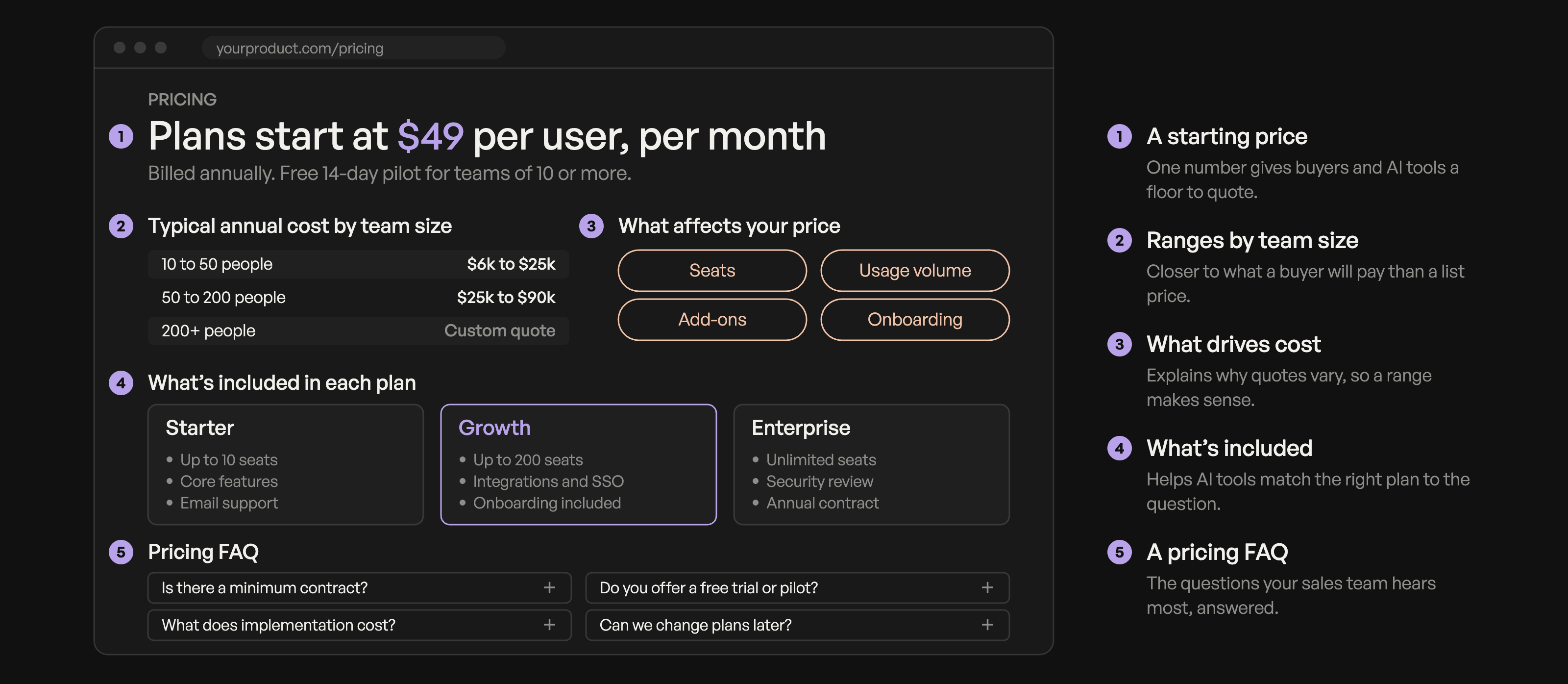
- A starting price, like “Plans start at $X per month.” (you’ll see this method on my own site pages)
- Typical ranges by team size, like “Most teams of 10 to 50 people pay between $X and $Y a year.”
- What affects the price: seats, usage, add-ons, onboarding or implementation.
- What's included in each plan, even if you don't show the numbers.
- Minimums, contract length and whether there's a free trial or pilot.
- A pricing FAQ that answers the questions your sales team hears most.
Then make sure your G2, Capterra and marketplace profiles match what your site says. If they don't, AI tools have two different answers to choose from. I go into reviews and profiles more in Building off-site authority: why it matters for AI search.
How do you check what AI tools say about your pricing?
This takes about ten minutes, and I'd do it today. Ask ChatGPT, Perplexity and Google's AI Mode a few questions like:
- “How much does [your brand] cost?”
- “[Your brand] pricing for a 20-person team”
- “Is [your brand] cheaper than [competitor]?”
For each answer, check whether it's right, which plan it's talking about and where the information came from. Then check again every month or so. A wrong price in an AI answer is a content problem you can fix, and I talk about tracking accuracy in more detail in SEO vs GEO.
Ask each question two or three times, since the answer can change. In my study, asking the same question again gave the same result 89% of the time. Look at the ads under Google's AI Mode answers too. Google showed an ad next to 117 of the 150 AI Mode answers I checked, and many of them were from competitors.
So, does hiding your pricing cost you?
It can, yes. If you say nothing, AI tools will say something for you, and it won't always be accurate or helpful. You don't need to publish every number, but give buyers and AI tools enough clear, current detail to answer the basic question: roughly what will this cost me?
Not sure what AI tools are saying about your pricing?
I can help you find out, and build pricing pages that answer the questions buyers are asking. My AI search optimization audit shows what AI tools say about your business, pricing included, and content strategy turns that into a plan your writers can work from. See more on how I work with in-house teams here.

Written by Aliya Conrad


more thoughts