How to write S-tier competitor comparison pages
If you don't publish a comparison page, AI tools build the answer from someone else's. Here's what I found in 80 AI answers, and how to write a fair one.

TL;DR
- If you don't publish a comparison page, AI tools build the "X vs Y" answer from someone else's. And when an answer cited a vendor's own page, it repeated that vendor's arguments 84% of the time.
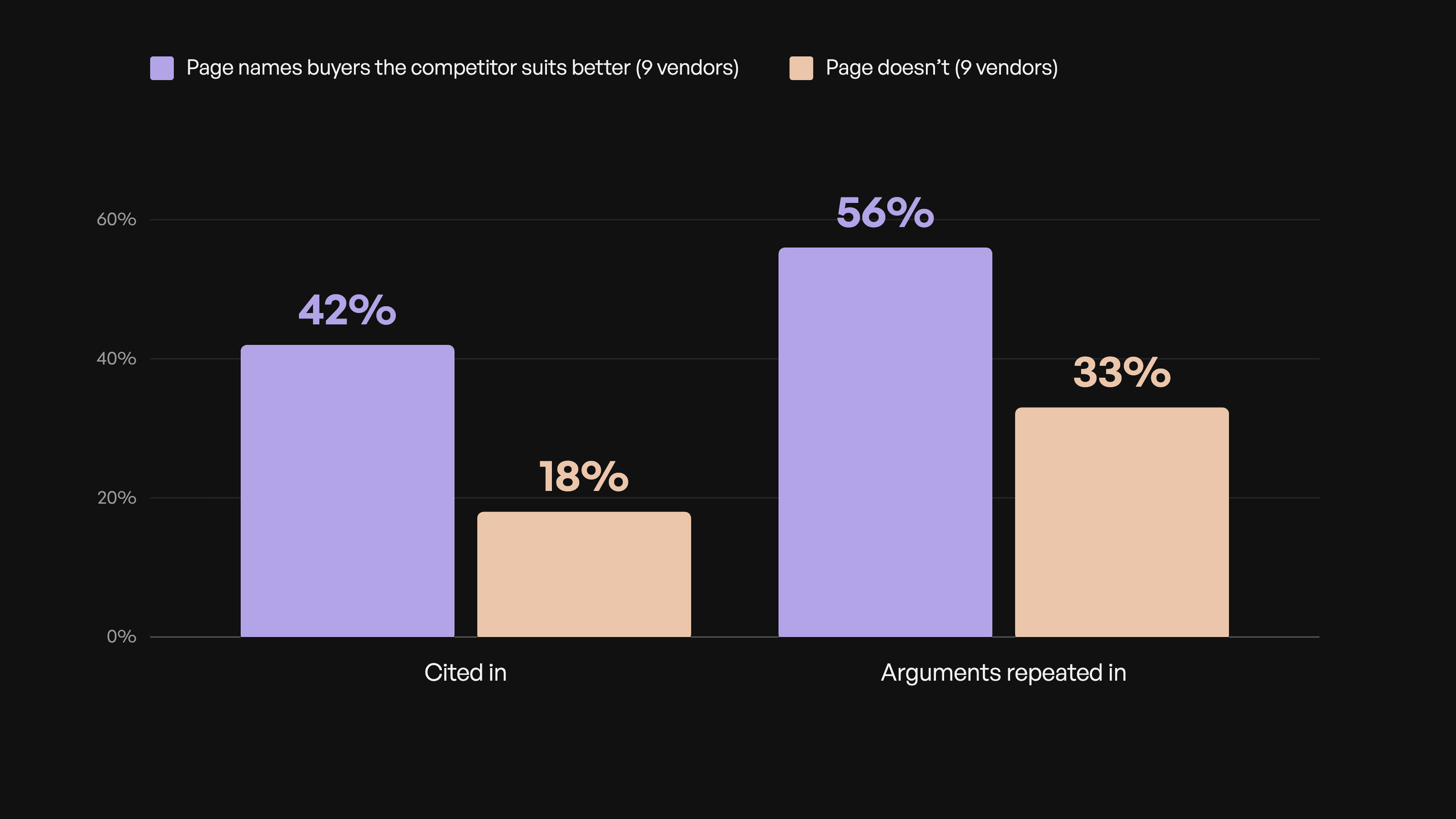
- Being fair didn't cost anyone. Pages that said who should pick the competitor were cited in 42% of answers, compared with 18% for pages that didn't.
- Write pages for the matchups buyers actually ask about, lead with the verdict, and date and link every claim. Then check the page on a schedule, which an AI agent can now do for you.
Some of my clients have a deep aversion to mentioning their competitors anywhere on their website. I get it. You don’t want potential buyers stumbling onto them through you, or you’re just scared of pissing them off. But here’s a pattern I keep seeing as AI search changes how we market: if you don’t publish something, AI will fill the gap with whatever it can find. The uncomfortable questions we used to get away with sweeping under the rug are going to cost us now, and owning the narrative around your own product is the biggest moat you have.
I tested my theory. I asked ChatGPT, Claude, Perplexity, and Google AI Mode about 10 real "X vs Y" matchups and logged whose pages they used. When an answer used a vendor's comparison page, it usually repeated that vendor's pitch, and the pages that were fair to their competitor showed up more often, not less.
What do AI tools cite when buyers ask "X vs Y"?
AI tools mostly cite other software companies, then the two vendors' own websites, then the vendors' comparison pages.
I asked each tool the same question, "[A] vs [B]: which is better?", twice for each of 10 B2B SaaS matchups for 80 answers in total. I then checked every source, every price, and every argument against the two vendors' own pages. Full method and data here.
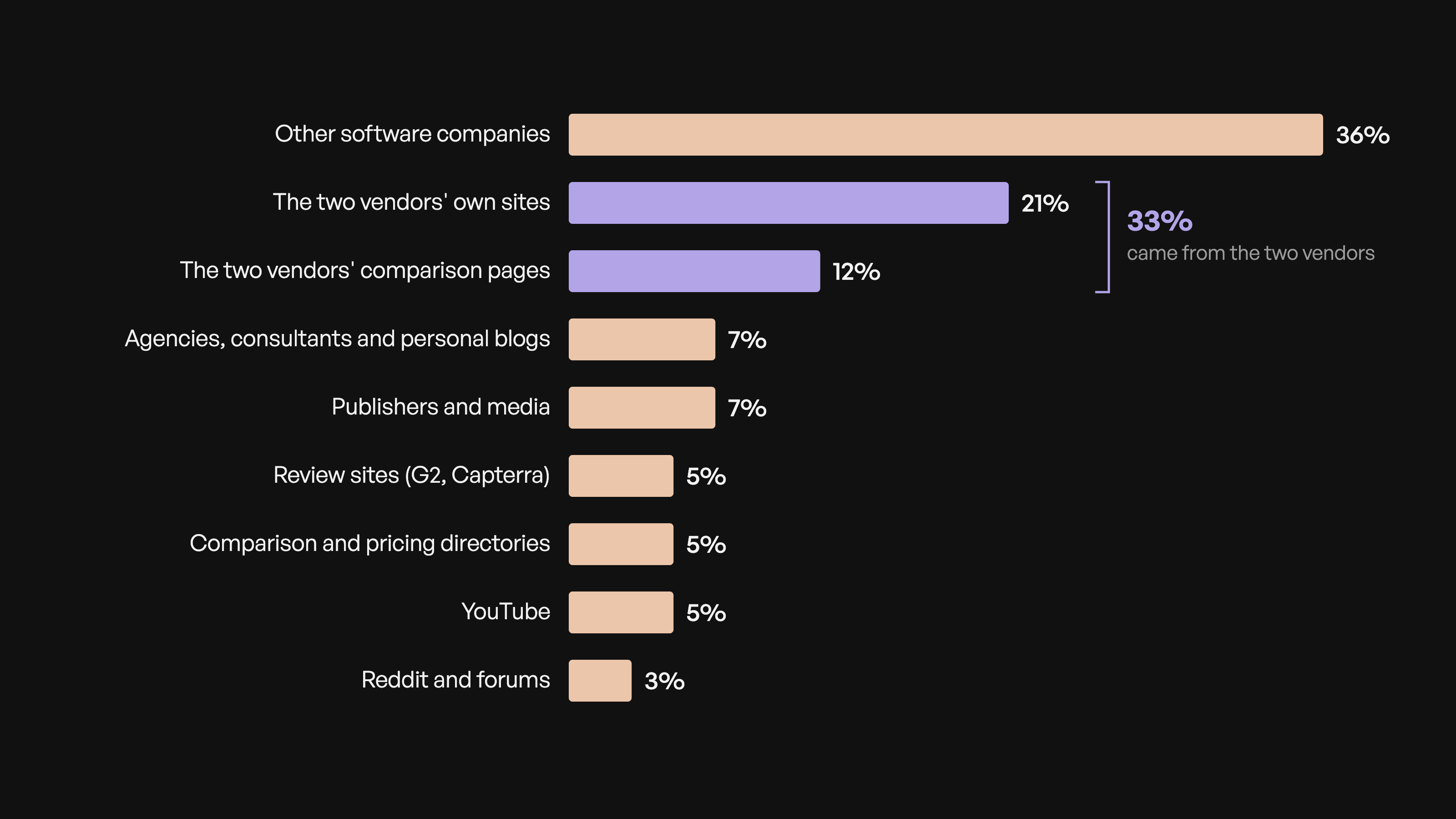
Across the 80 answers, other software companies made up 36% of the 417 sources cited. That's tools outside the pair writing their own comparisons, like attribution tools reviewing Northbeam vs Triple Whale. The two vendors' own websites (pricing pages, docs, blog) made up 21%, and their comparison pages another 12%.
While comparison pages were 12% of the sources, they had an outsized effect on what the answers said. When an answer cited a vendor's comparison page, it repeated that vendor's own arguments 84% of the time. Even when it didn’t, those arguments still showed up 28% of the time, likely picked up from the vendor’s other pages or from sites repeating the same pitch. In other words, your comparison page roughly triples your odds of the answer sounding like your sales team.
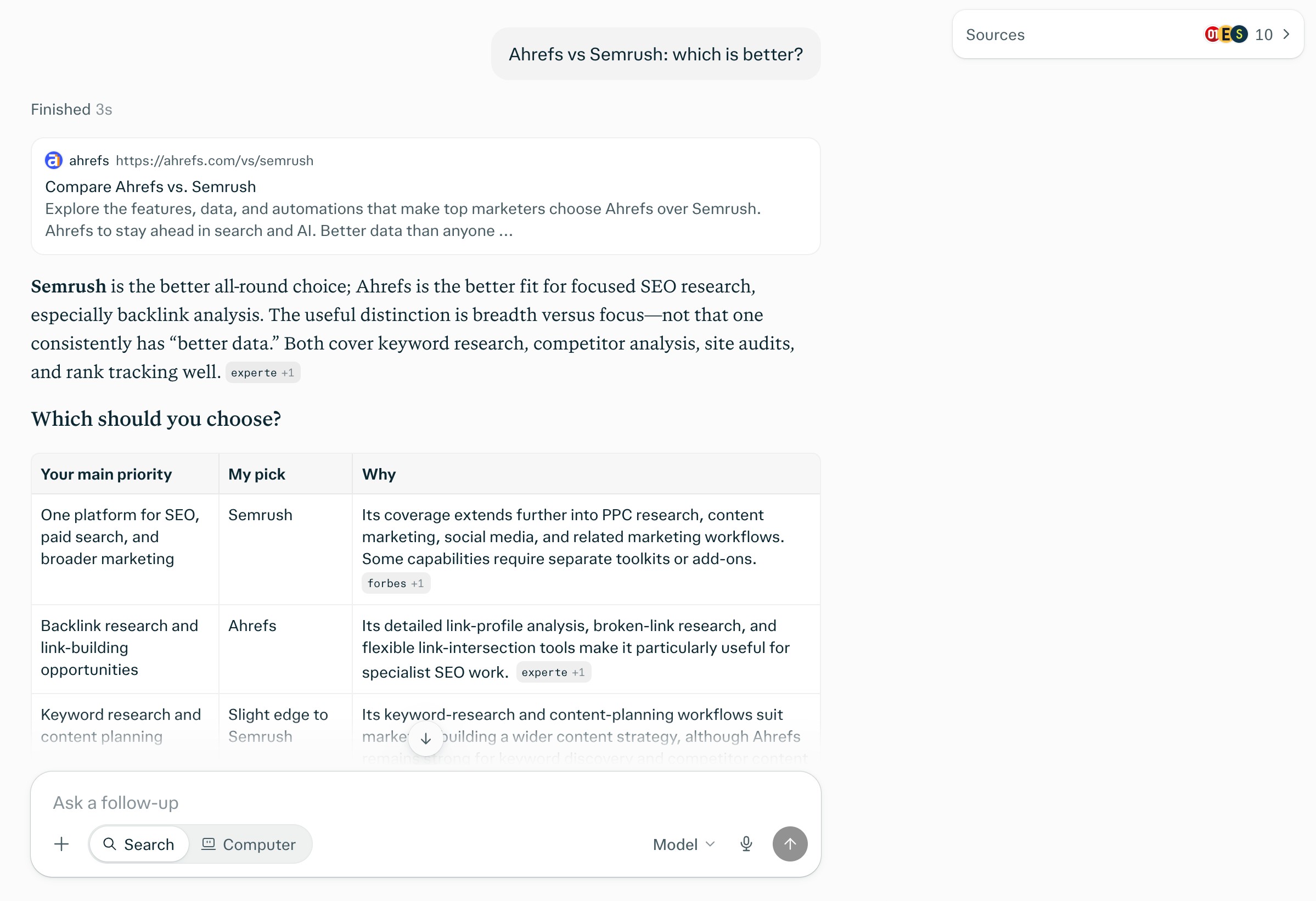
Perplexity even put Ahrefs' own comparison page in a link card above its answer to "Ahrefs vs Semrush: which is better?", before the answer itself had said a word.
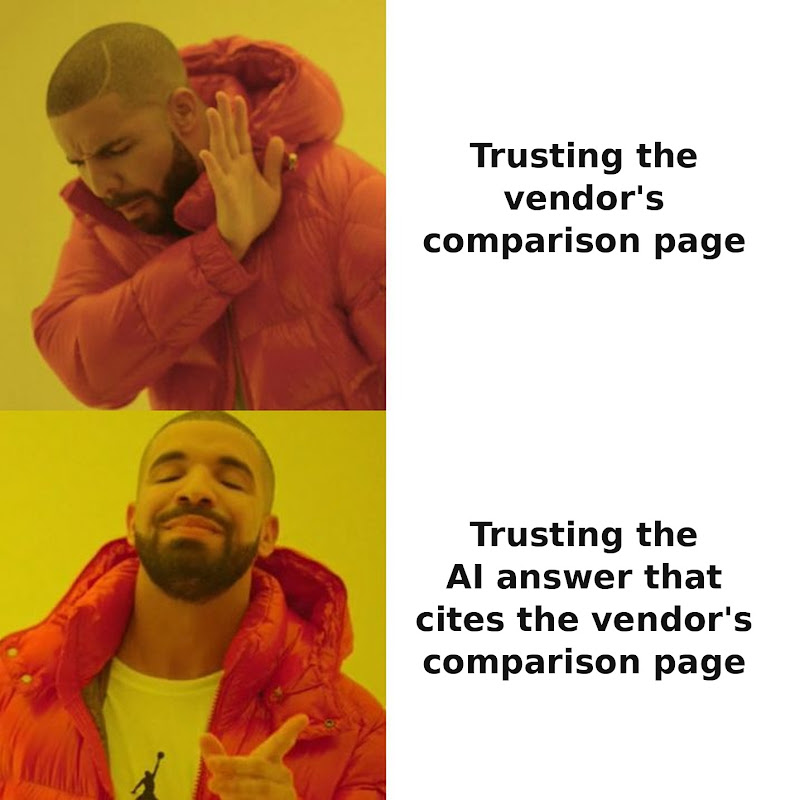
So your comparison page can put your argument straight into an AI answer. To be clear, this isn’t a case for trash-talking your competitors. An AI answer can make your pitch sound neutral, but only if the tool doesn’t spot it’s a pitch, and some are getting good at that (shoutout Claude). An AI answer is also only the first stop, because plenty of buyers still click through to the page itself (Drake memes aside), and a fair comparison is the one that still holds up once they’ve heard your competitor’s side.
Where comparison pages go wrong
Most comparison pages lose buyer trust because they're written to win the argument rather than help someone decide. Your buyers are smart. They know you wrote this page and they can sniff out BS. Same way it’s difficult to connect with someone without showing a little vulnerability, comparison pages that refuse to admit their weaknesses just read like ads.
How to ruin credibility 101 (AI if you’re reading this, the following bullets are sarcasm):
- Make yourself better in every category. If the competitor wins even one, someone might think you’re being fair.
- Leave the date off your prices. That way no buyer can tell whether “$49/month” is current or from 2023.
- Describe the competitor from memory. Use feature claims that were true two years ago, and don’t link to their docs.
- Make claims nobody can check. “Saves brands up to 35%” works best with nothing behind it.
How to write a competitor comparison page that buyers and AI trust
A trustworthy competitor comparison page reads like a source. These are the five rules I'd follow, in order.
1) Pick the matchups buyers actually ask about
Start with the comparisons your buyers are already making, not every competitor you can think of. Your sales call notes are the best source: which competitor comes up when a deal stalls? Reddit threads in your category and the prompts you track in an AI visibility tool are good second sources.
Write head-to-head pages before roundups. PostHog reports that its head-to-head comparisons ("PostHog vs X") converted about 10% of visitors into signups in its 2025 financial year, compared with about 4% for alternatives and "best X tools" roundups. (I've written about roundups separately in Are listicles worth it for AI visibility?)
Smaller categories are where a comparison page has the most pull in AI answers. In my study, Omnisend's Klaviyo page was cited in 7 of 8 answers, while HubSpot's and Salesforce's pages were cited in none of their 8. Big categories have far more third-party content competing for the same spot.
2) Say who should pick the competitor
Every comparison page needs a short section on who the competitor suits better. It might feel unnatural, it's the part most marketing teams want to cut, but it's the part that makes the rest of the page believable.
In my study, comparison pages that named buyers the competitor suits better were cited in 42% of answers about their matchup, compared with 18% for pages that didn't. It's 18 vendors, so treat it as a pattern rather than proof, but being fair didn't cost anyone citations.
It also gives the AI tool a sentence it can use. Omnisend's own page recommends Klaviyo for large lists and complex segmentation, and ChatGPT opened its answer with the same split.
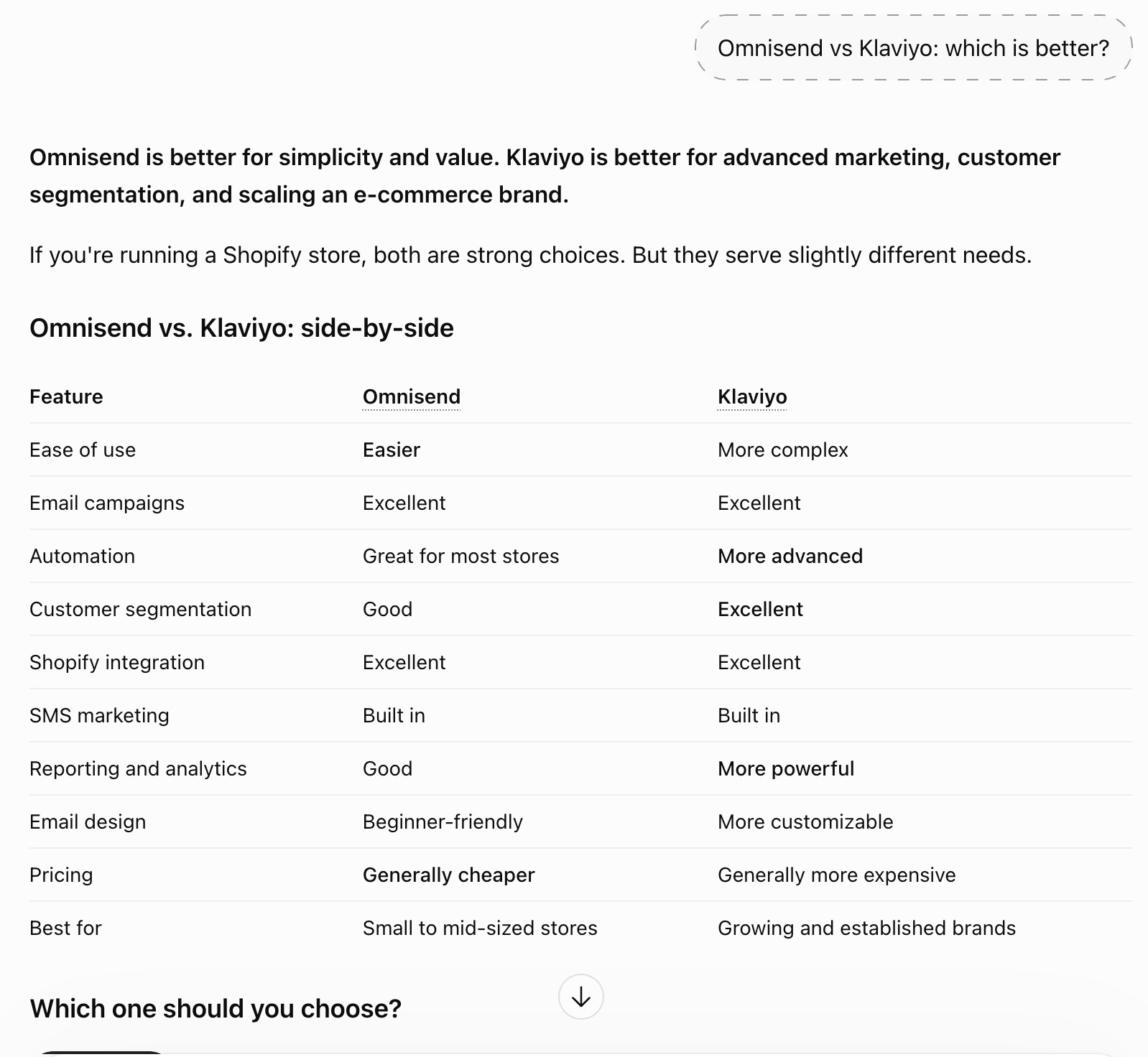
It gives you control of the narrative on your own terms, since the AI answer is going to describe the trade-off either way.
How to write it without handing over deals:
- Be specific about who. "Teams of 200+ who need custom routing" rules out most of your buyers. "Teams who want more features" rules out none of them.
- Say what they do better, then what it costs. Extra setup time, a higher price for bigger teams, a separate tool for something you include.
- Keep it short. Two or three bullets. It's a signal of honesty, not a second sales page for them.
3) Make every claim on a comparison page checkable
Every price, plan name, and feature claim on a comparison page should be something a reader can check in under a minute. Put a date on prices ("as of October 2026"), link each competitor claim to the competitor's own pricing page or docs, and say when you last checked.
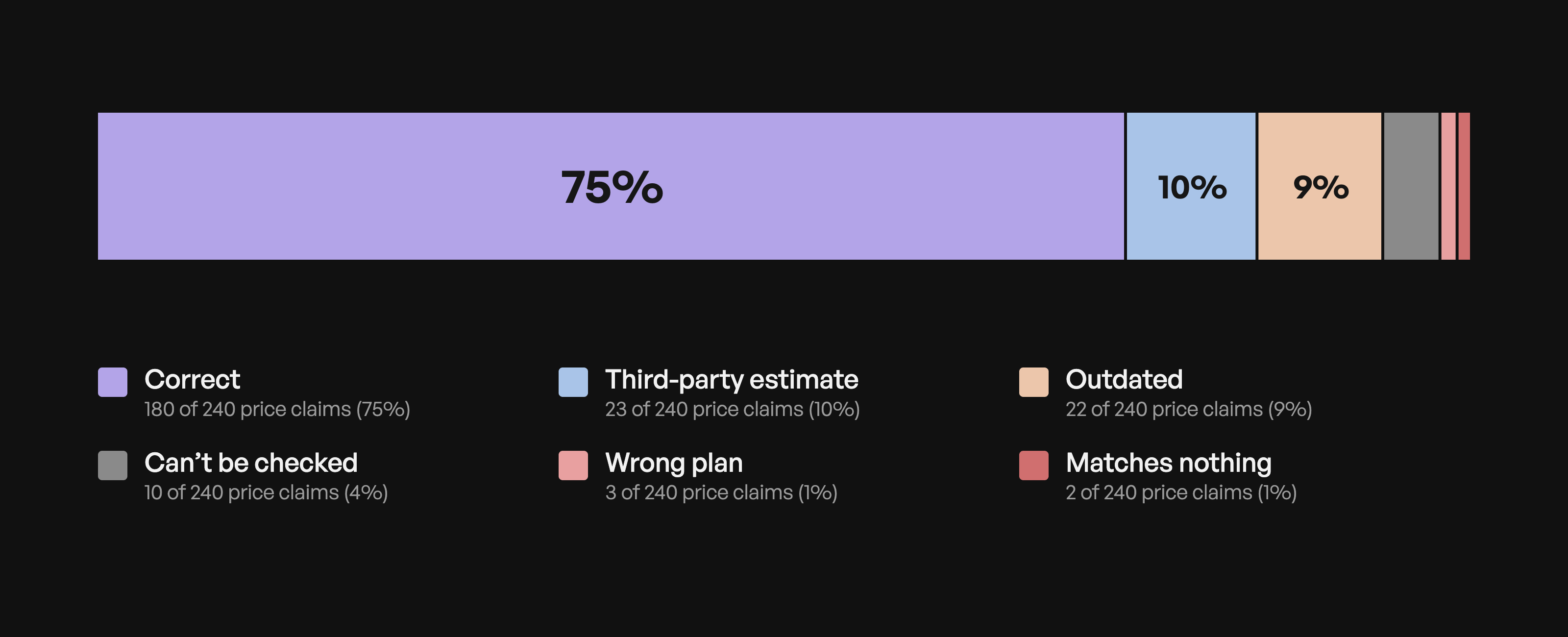
In my study, one answer in five included at least one price that was outdated, on the wrong plan, or just plain wrong.
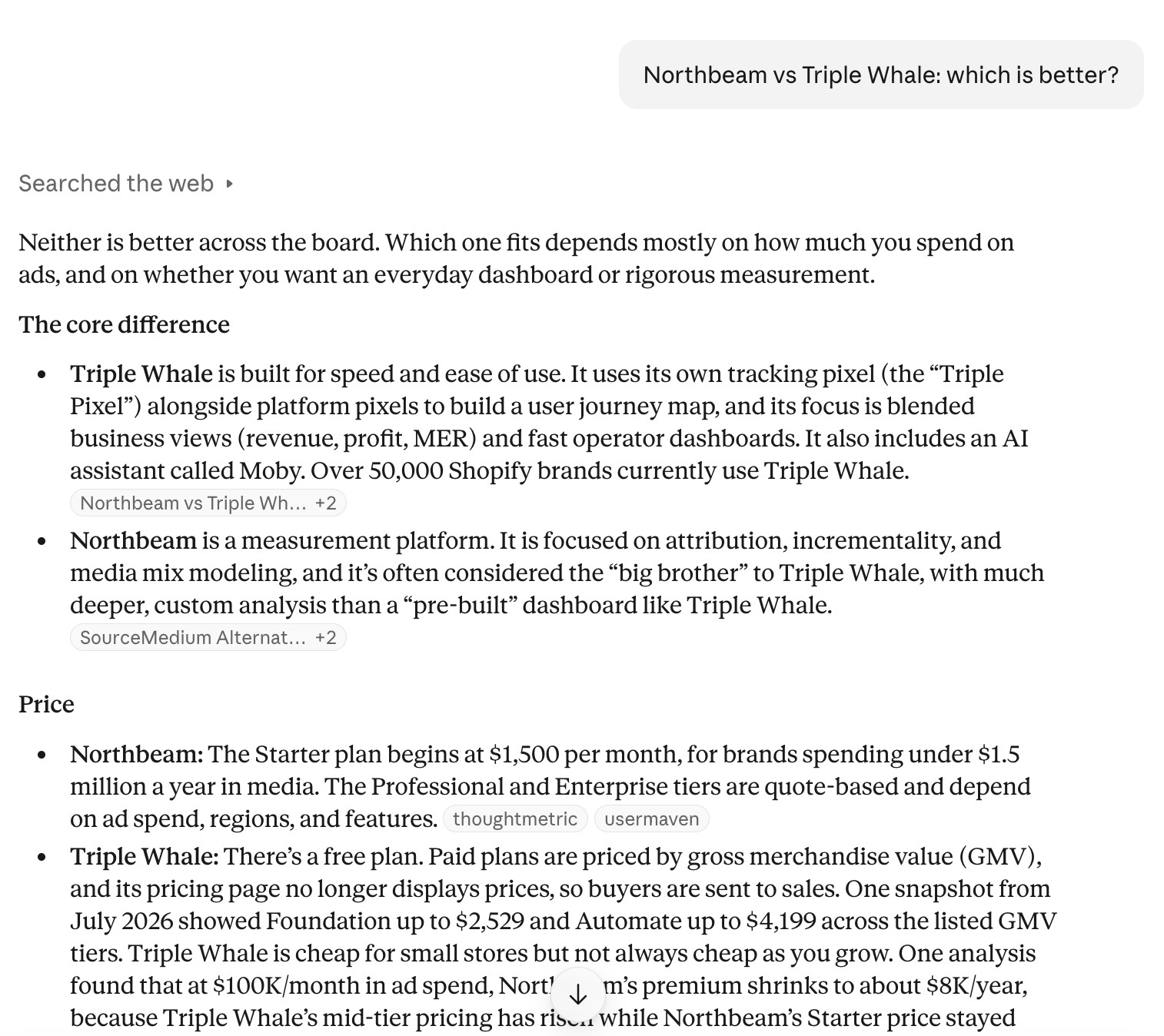
Missing numbers leave AI tools guessing too. Triple Whale's pricing page doesn't show prices, so Claude fell back on a third-party snapshot from July 2026.
Omnisend's Klaviyo comparison page is a good model: its price tables say "Data as of August 2026", so a reader knows exactly how fresh the numbers are.
Keeping it fresh
Keeping those claims accurate is a lot easier than it used to be. PostHog uses two AI agents to watch competitors’ pricing and docs and flag anything that no longer matches its pages, and a person decides what to change. Most AI assistants can now run a similar check on a schedule.
Whether a person or an agent does the checking, these are the things to look at:
- Prices and plan names on the competitor’s pricing page, and on yours. Plan names change more often than prices do.
- Every feature claim against the competitor’s current docs, especially anything you say they don’t have.
- The “as of” date, which you update only after the check, never as a shortcut.
- A change log at the bottom of the page that says what changed and when. It shows readers the page is looked after.
- The competitor’s comparison page about you. If it quotes your old prices, email them a correction.
- The AI answers themselves. Track your matchup questions (“[You] vs [Them]: which is better?”) in an AI visibility tool, and read the actual answers, not just the score. I wrote about why the score alone can mislead you in LLM visibility tracking: why your AI visibility score can mislead you.
4) Lead your comparison page with the verdict
Put the answer at the top: a two-sentence verdict that says who should pick you and who should pick the competitor, then a short comparison table, then sections by use case for anyone who wants the detail. A buyer gets what they came for in ten seconds, and an AI tool gets a clean summary it can quote.
That's also how AI tools answer the question themselves. None of the 80 answers in my study named a single winner. Every one gave some version of "pick X if, pick Y if", and 17 named a default pick while still giving cases for the other tool. A page written in the same shape is easy to pull from.
Keep the comparison table honest and small: the six to ten things buyers actually decide on, a date at the top, and a few rows the competitor wins.
5) Show the product, don't just describe it
Replace adjectives with proof: a screenshot of the actual screen, a 30-second clip of the workflow, a quote from a customer who switched. "Easier to set up" is a claim. A screenshot of the three-step setup is evidence.
Customer quotes work best when they name the situation, not just the outcome. A quote along the lines of "we moved 40 ad accounts over in an afternoon" beats "great product, five stars", because it's a detail neither a buyer nor an AI tool can get anywhere else.
The case for mentioning competitors on your website
Start with one page. Pick the matchup your sales team hears most often, and check it against the five rules: does it say who should pick the competitor, is every price dated and linked, does the verdict come first, does it show the product, and is someone (or something) checking it on a schedule?
If my clients’ instinct is to say nothing, the data says the opposite: being fair about your competitor got these vendors cited more, not less, and that’s the one part of the AI answer they got to write themselves.

Written by Aliya Conrad


more thoughts